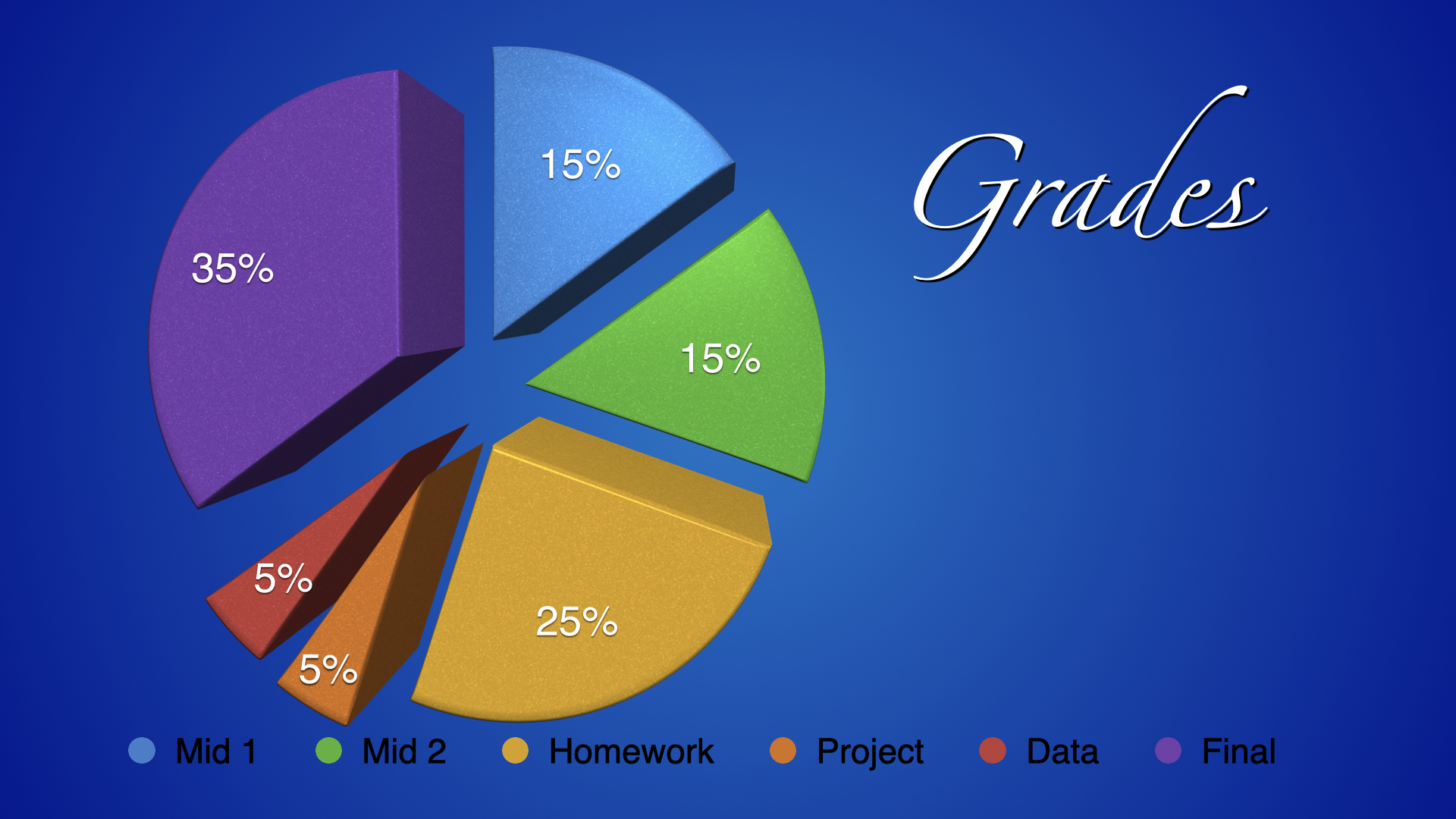
Q: What is the grade breakdown?
This was communicated in the first lecture of this course which I hope
everybody who is enrolled has seen and which also has not changed. Nothing else
has else changed from the syllabus. We discard the least 3 HW scores for example.
The grade slide is usually the most interesting thing for students and it is surprising
if somebody would miss that. By the way: the information on the brochure is from
a time before the course started and is outdated, we have given more weight to the data
projects for example. What we have communicated to the
class at the beginning of the course counts and it is your responsibility to know this.
Of course, it is always ok to ask again and some have done so that the relevant slide is shown
below. [P.S. if you should hear any conflicting information about grades breakdowns or course policy
from other sources than me then better check with Oliver.]
Q: What about collaboration?
A: For homework, it is fine to discuss
the material with others, instructors but you have to write up things yourself. During
exams, absolutely no collaboration or consultation with others is allowed. This is strictly
enforced. Any anomalies would be investigated. And consequences would be severe. Look at the
Harvard honor code.
Please write your homework by hand. For exams, we need you to submit the exam answers handwritten too.
Bout homework: you need to do write it down on your own. No Biff cheats from ``Back to the future":
Q: Do we need a textbook? A: you can take the course without
textbook. Our time is limited and it might be a good idea to focus on how we go through the
material which is very efficient. Textbooks like Stewart have about 1000 pages.
A popular choice had been Multivariable Calculus: Concepts and Contexts (any edition).
I will say more about this in the first class.
Q:How much pre-knowledge is needed.
This is written in the description of the course.
Here is a 5 imes 5 checklist.
In general, mathematics is hard. It is the hardest of all sciences. Also after teaching calculus for 30 years, there are
always new aspects to see. Especially geometry of three dimensional space
can be challenging. It is important to develop geometric thinking and visualization skills.
We will say more about this in the first lecture.
Q:What about academic integrity?. We strictly follow to the
Harvard honor code. If you can not follow
this, you should not participate in any summer school course. Any violation of the code
is taken seriously and has severe consequences. Actual humans grade the assignments and we also
ask you only handwritten material and not typed up material which gives us some control to verify
that it was you did the work. If you have no confidence that you can follow
the code, you should not take this course (nor any other course at Harvard!).
Q:Do I have to participate actively? Yes,
the lectures are done by zoom. Having taught distance since a couple of years already in various
formats (first at the extension school in 2014 in a hybrid, and the first time using Zoom
in 2017)
and now in the spring of 2020
at the Harvard College, I have to ask you also to join the lectures with video. We do not record the class
and also ask you not to record it. This is the analog of showing up in person in a lecture.
There is the possibility to keep some privacy
like using backgrounds in Zoom, in case you do not want to see other parts of your environment. We want you to
interact with teaching staff and peers like in person and we are all humans and not robots or avatars. Especially
when working during class in groups.
If you are uncomfortable with this, please choose a course, which allows ghosts to participate.
If you are for some reason not able to join with video, maybe by technical or other reason, please write
Oliver an email and explain. There are reasons for which we can make an exception.
Q:Will classes be recorded? A: This is a FAQ. The answer is no.
Some basic theoretical content is also available on youtube videos but the classroom will also feature
discussion and working on problems and to be a safe place, where one can make mistakes and ask any type
of questions without having this being recorded.
So, if you can not make it to the actual class, this is not the course for you. We understand
that this can produce difficulties in a different time zone. If it is impossible that you can
participate, chose an other course which meets at a different time. If we would meet all on campus,
you would also be expected to show up regularly to class. We understand that this can force you
a shift of time for a couple of weeks but we usually adapt quickly also when traveling.
Jet lag disappears in a few days.
Q:How much time you have to spend per week?A: There are 6 hours of lecture every week,
4 homework units per week (each expected to take each 2 hours in average), discussions with instructors
in office hours or problem sessions (about 2-4 hours in average) and then you need time to digest,
read, polishing notes etc. In average, students spend about 15-20 hours of uninterrupted time
per week for such a course. This is
an average, some use more time and of course as more time you think about math as better.
So, if you can not allocate this time, this course is not for you. Mathematics is hard to learn in
general, like anything which is precious.
Q:How are assignments submitted?A: Homework and exams are submitted electronically in PDF format. We ask you to hand-write and not
to type you work up. We can read between the lines from actual handwriting also have more
possibility to check academic integrity. It is important to work on paper (or some
electronic device like an Ipad, where you can write like with paper and pencil. This counts still as
handwritten, as long as no text mode used). If you submit work on paper,
use a scanning app on the phone which produces good PDF documents from work done on actual paper. Make sure
to use settings which produce reasonable file sizes.
Each unit is submitted separately as
it will be graded by different people in the teaching team. You should be fine if you have a scanner or
an app on your phone which can scan documents which consist of one PDF document. Note that each
unit is submitted separately. We will make some recommendations in the first lecture.
Q: Is this course curved?A: There are different things which students
usually understand with ``curving", some associate with it fixed cut-off levels,
others quote like a certain percentage for each grade bin. Neither is implemented here
(nor is in most college courses). We are forced at the end to assign a letter grade [0-100] to
numerical values A-F and this by nature defines a curve. It is a function f(x) = y, where
y is the letter A-F and x is a number 0-100. The function f will be determined at the end.
By experience, the x-data distribution usually is a tilted Gaussian distribution.
Every student will at the end know both the value x and y.