|
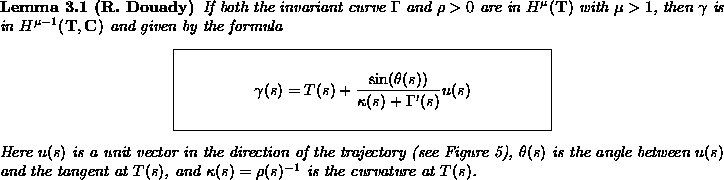
 satisfying
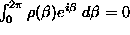 defines a strictly
convex table T by
defines a strictly
convex table T by
 is the radius of curvature at the point T(s).
Douady remarked that a k-times differentiable invariant curve
 of a (k+1)-times differentiable table
defines a (k-1)-times differentiable caustic [8].
In order to reformulate this result also for intermediate degrees
of smoothness, it is convenient to pick
of a (k+1)-times differentiable table
defines a (k-1)-times differentiable caustic [8].
In order to reformulate this result also for intermediate degrees
of smoothness, it is convenient to pick  in one of the Hilbert spaces

which are all contained in the Hilbert space  of square integrable
periodic functions. For
of square integrable
periodic functions. For  ,
a function in
,
a function in  has a uniformly convergent
Fourier series
has a uniformly convergent
Fourier series 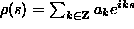 .
Moreover, if
.
Moreover, if  with
with  ,
then
,
then  is r times
continuously differentiable.
We use here
is r times
continuously differentiable.
We use here  mainly for notational reason in order to control
with a single parameter
mainly for notational reason in order to control
with a single parameter  both nowhere-differentiable
and smooth situations. Not much is lost for a reader who decides to
ignore the spaces .
both nowhere-differentiable
and smooth situations. Not much is lost for a reader who decides to
ignore the spaces .
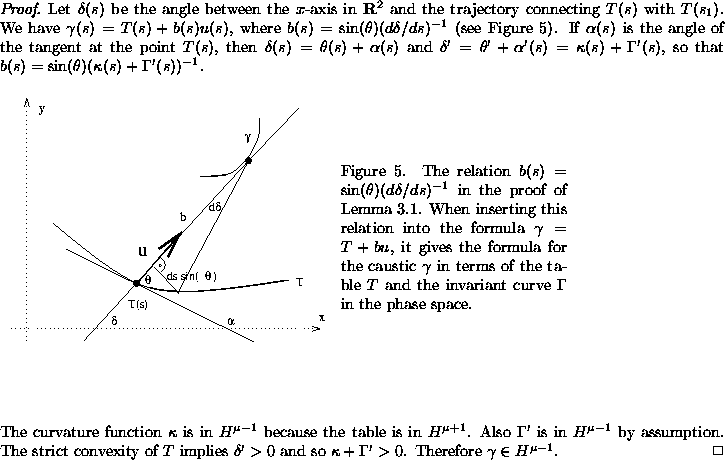
In [14] the authors ask how to define, in general, a caustic
of a convex two times differentiable
table whose invariant curve is only Lipschitz.
The equation in Lemma 3.1 does this
for a table with invariant circle and bounded
measurable curvature function  .
Because the derivative
.
Because the derivative  is also a
bounded measurable function by
Birkhoff's theorem (for a proof see [16] p.430), the image of the
function
is also a
bounded measurable function by
Birkhoff's theorem (for a proof see [16] p.430), the image of the
function  is in general a measurable set
in the complex plane.
is in general a measurable set
in the complex plane.