
|
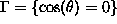 is an invariant curve of the
billiard map, then each trajectory belonging to an orbit on
is an invariant curve of the
billiard map, then each trajectory belonging to an orbit on  both leaves and hits the table orthogonally. The period of the orbit is then
2. Because each of these orbits is a critical point of the length functional,
the distance between the two impact points is constant and
the table T is consequently a curve of constant width.
It is more convenient to parametrize such a table by the angle
both leaves and hits the table orthogonally. The period of the orbit is then
2. Because each of these orbits is a critical point of the length functional,
the distance between the two impact points is constant and
the table T is consequently a curve of constant width.
It is more convenient to parametrize such a table by the angle  of the tangent to the boundary instead of using the arc length s of the table.
The table is of constant width if
of the tangent to the boundary instead of using the arc length s of the table.
The table is of constant width if
 satisfies
  .
If
.
If  , then
  .
In the case, when the invariant curve
satisfies
.
In the case, when the invariant curve
satisfies  , the formula in Lemma 3.1 simplifies to
which is the formula for an evolute of the table T (see [5])).
If we plug in the Fourier series
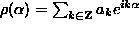 , we get

We need  to assure that the table is closed.
The condition
to assure that the table is closed.
The condition  holds if
  for
for
 . For to be real, we have to require also
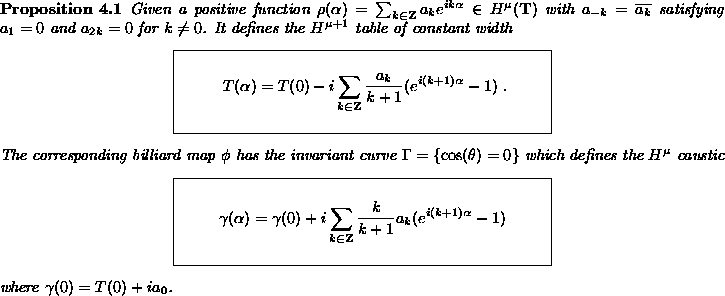
 . We summarize:
|
|
|
|
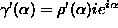 which shows that
has the same critical points as
which shows that
has the same critical points as  . In other words,
the vertices of T correspond to cusps of .
. In other words,
the vertices of T correspond to cusps of .
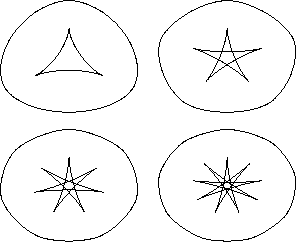
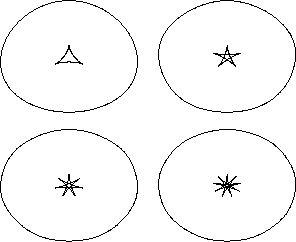
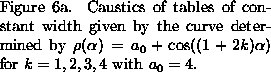
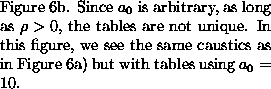
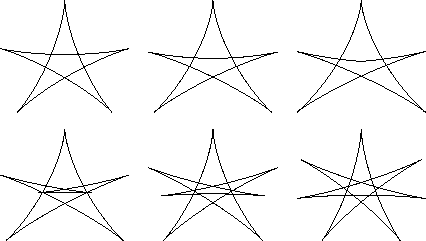
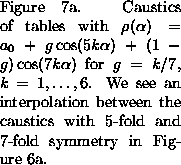
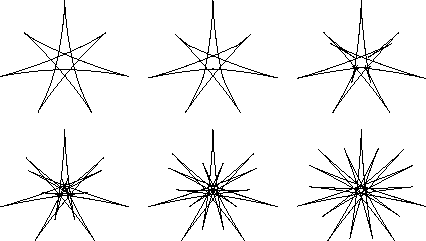
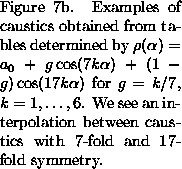
The caustics in Figures 6,7 were drawn
using trigonometric polynomials  .
While the functions were real analytic, in general,
the image of has singularities.
Indeed, the function
.
While the functions were real analytic, in general,
the image of has singularities.
Indeed, the function  has at least N zeros if it is a trigonometric
polynomial of degree N [22]. If the zeros are simple,
the curve has at least N cusps counted with multiplicity.
Note that for the caustics belonging to the invariant curve
has at least N zeros if it is a trigonometric
polynomial of degree N [22]. If the zeros are simple,
the curve has at least N cusps counted with multiplicity.
Note that for the caustics belonging to the invariant curve
 , the map is 2 to 1.
Next: Nowhere differentiable caustics Up: On nonconvex caustics of Previous: Caustics of convex billiards
Oliver Knill