 depend on the caustic
  .
We assume
.
We assume  and that (0,0) is contained in the
convex hull of . The set
and that (0,0) is contained in the
convex hull of . The set  of closed
convex caustics satisfying these conditions is a compact
metric space when equiped with the Hausdorff metric.
of closed
convex caustics satisfying these conditions is a compact
metric space when equiped with the Hausdorff metric.
|
How does the rotation function
depend on the caustic .
We assume and that (0,0) is contained in the
convex hull of . The set of closed
convex caustics satisfying these conditions is a compact
metric space when equiped with the Hausdorff metric.
Let  and let
  .
Set
.
Set  .
By Corollary 2.2,
.
By Corollary 2.2,  is a closed connected set. We disregard the case when
is empty and consider the dichotomy:
i)
is a closed connected set. We disregard the case when
is empty and consider the dichotomy:
i)  has a nonempty interior; ii) is a single point
 . By Corollary 2.2, the latter happens
if and only if the homeomorphism
. By Corollary 2.2, the latter happens
if and only if the homeomorphism  is conjugate to the
rotation by
is conjugate to the
rotation by  . In the case ii), we say is
p/q-exceptional. Let
. In the case ii), we say is
p/q-exceptional. Let
 be the set of exceptional caustics.
We say that
be the set of exceptional caustics.
We say that  are p/q-nonexceptional, and
call a phase locking interval. The set
are p/q-nonexceptional, and
call a phase locking interval. The set
 consists of exceptional caustics.
Its complement
consists of exceptional caustics.
Its complement  is the set of
nonexceptional caustics.
is the set of
nonexceptional caustics.
Remarks.
1) The set  contains all ellipses.
The Birkhoff-Poritsky conjecture is equivalent to the statement that
is equal the set of ellipses.
contains all ellipses.
The Birkhoff-Poritsky conjecture is equivalent to the statement that
is equal the set of ellipses.
2) The set  is the set of tables of equal width.
3) The set  is nonempty [14]. The same construction
seems sto generalize and lead to nonempty
is nonempty [14]. The same construction
seems sto generalize and lead to nonempty  .
.
Recall that a subset, Y, of a compact metric space is a  , if Y
is a countable intersection of open sets.
Sets containing dense
, if Y
is a countable intersection of open sets.
Sets containing dense  are called residual or
Baire generic (see [24]).
are called residual or
Baire generic (see [24]).
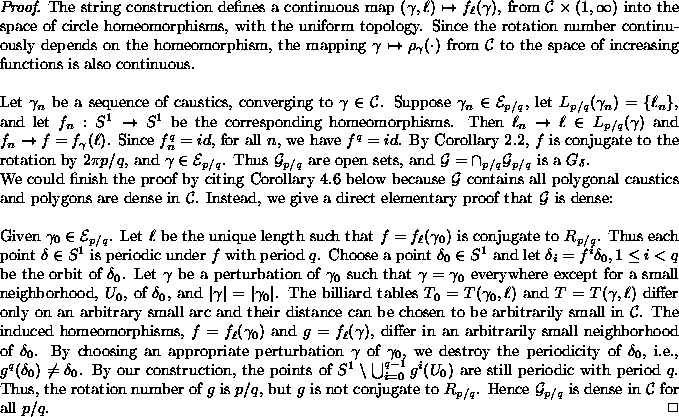
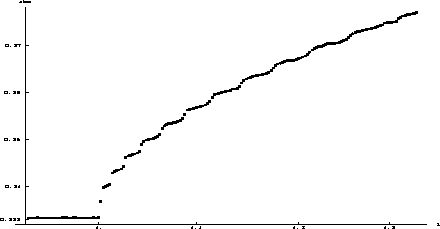
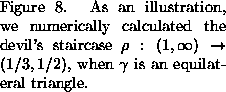
A continuous nondecreasing function
 is called a devil's staircase if
there exists a family of disjoint open intervals whose union is
dense in I, such that
is called a devil's staircase if
there exists a family of disjoint open intervals whose union is
dense in I, such that  takes distinct constant values
on these intervals [16].
A subset of a compact metric space is residual if it contains
a dense .
takes distinct constant values
on these intervals [16].
A subset of a compact metric space is residual if it contains
a dense .

|
|

