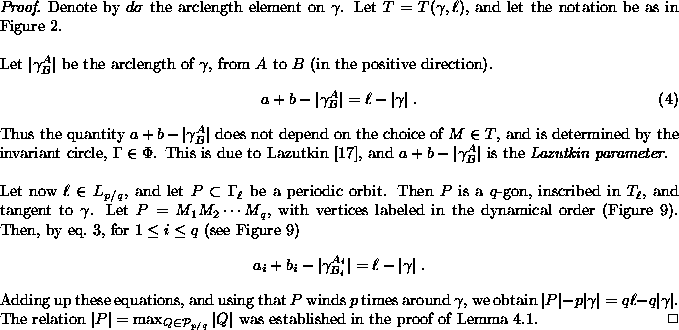
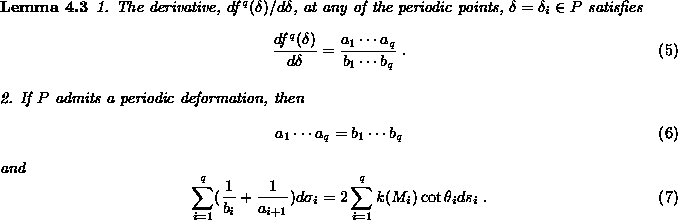
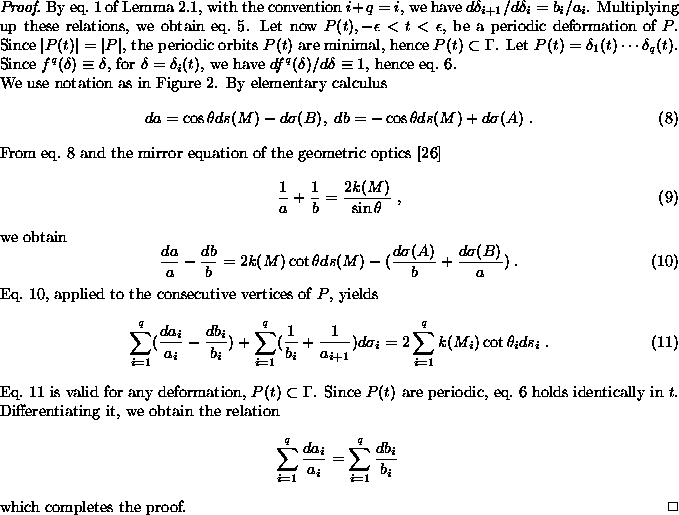
|
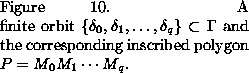
 with rotation number p/q [18, 15, 16],
the periodic orbits of type (p,q)
(Figure 9). We denote by |P| the perimeter of any inscribed polygon.
For rational p/q, let
with rotation number p/q [18, 15, 16],
the periodic orbits of type (p,q)
(Figure 9). We denote by |P| the perimeter of any inscribed polygon.
For rational p/q, let  be the space of ordered q-gons,
inscribed in T, and winding p times around T. Periodic
orbits of type (p,q) are the critical points of the function
be the space of ordered q-gons,
inscribed in T, and winding p times around T. Periodic
orbits of type (p,q) are the critical points of the function  on
. The polygons
on
. The polygons  that maximize |P| are the
minimal orbits of type (p,q) because the action is the negative of
the length. Besides minimal periodic orbits there are minimax orbits,
that maximize |P| are the
minimal orbits of type (p,q) because the action is the negative of
the length. Besides minimal periodic orbits there are minimax orbits,
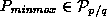 .
.
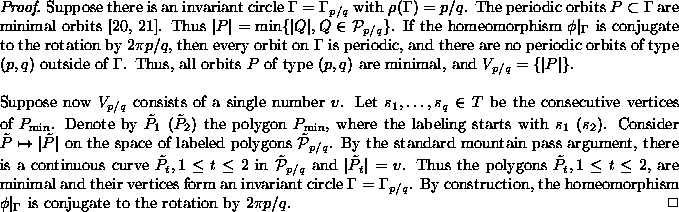
Lemma 4.1 extends obviously to arbitrary area-preserving twist maps, where the action functional replaces the length. Invariant circles with rational rotation number happen for a thin set of twist maps.
|

|
 ,
as
,
as  runs from 1 to
  ? By eq. 3,
  for
for  . This implies that v is not differentiable
near the boundary of a nontrivial phase locking interval because arbitrarily
nearby, it has arbitrarily large derivatives. However,
. This implies that v is not differentiable
near the boundary of a nontrivial phase locking interval because arbitrarily
nearby, it has arbitrarily large derivatives. However,
 is monotone and so differentiable almost everywhere.
The phenomenon of phase locking is related
in general to the lack of differentiability of the minimal action on
parameters.
is monotone and so differentiable almost everywhere.
The phenomenon of phase locking is related
in general to the lack of differentiability of the minimal action on
parameters.
Deformations of minimal periodic orbits.
A strictly convex piecewise  curve
curve  ,
parametrized by the arc length
,
parametrized by the arc length  is completely determined by its
radius of curvature
is completely determined by its
radius of curvature  .
We will assume that
.
We will assume that  is piecewise continuous.
At each of the finite number of points of discontinuity as well as at
the end points of the curve, we assume the existence of the one-sided
limits
is piecewise continuous.
At each of the finite number of points of discontinuity as well as at
the end points of the curve, we assume the existence of the one-sided
limits  .
.
A closed convex, piecewise curve is, by
our convention, a finite union of strictly convex arcs and straight line
segments called flat arcs. Let  be the subset of
piecewise caustics.
be the subset of
piecewise caustics.
If  belongs to a flat arc of or if
  belongs to a strictly convex arc and
  on at least one side,
we say that A is a flat point of . When
belongs to a strictly convex arc, and
on at least one side,
we say that A is a flat point of . When
belongs to a strictly convex arc, and  , we say that A is a
vertex or a corner point.
, we say that A is a
vertex or a corner point.
We will freely identify periodic orbits of the billiard map with polygons,
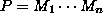 inscribed in T.
A periodic orbit, P is said to admit a deformation, if there exists a
continuous deformation
inscribed in T.
A periodic orbit, P is said to admit a deformation, if there exists a
continuous deformation 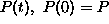 of periodic orbits P.
More precisely if
of periodic orbits P.
More precisely if 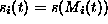 are the arclength
coordinates, we assume that
are the arclength
coordinates, we assume that  are continuous.
We will also consider one-sided deformations P(t),
are continuous.
We will also consider one-sided deformations P(t),  , or
, or
 , assuming the same conditions, except the derivatives
at t=0 are one-sided.
, assuming the same conditions, except the derivatives
at t=0 are one-sided.
|
|
be a convex caustic, and let  . Let
. Let
 be the invariant circle, let
  the induced homeomorphism, and let
  be a periodic orbit. We assume that the sides of P support the strictly convex
arcs of , and
be a periodic orbit. We assume that the sides of P support the strictly convex
arcs of , and  be the consecutive supporting points.
Let
be the consecutive supporting points.
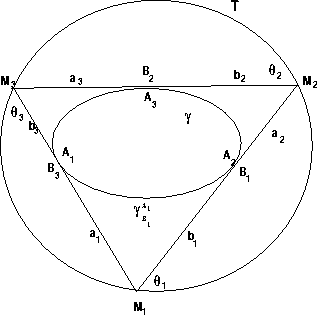
Let 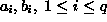 , be the supporting segments
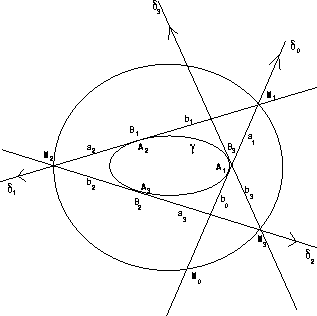
(Fig. 10). Denote by
, be the supporting segments
(Fig. 10). Denote by  , the curvature of T. Let
 be the arclength elements on
  respectively. Set
 . Finally, let
 be the exterior angles at
  (see Figure 10).
|
|

Remarks.
1) Let  be a billiard map, and let
 be an invariant circle. Let . If
  , then
 contains minimal periodic orbits of type (p,q). Periodic points,
 , satisfy
  . Typically, they are isolated.
2) If  , for a convex caustic , then
the one-sided derivatives,
, for a convex caustic , then
the one-sided derivatives,
 , exist, and are given by
eq. 5. The jumps of the derivative are due to the flat arcs of .
If is strictly convex, then f is , and
, exist, and are given by
eq. 5. The jumps of the derivative are due to the flat arcs of .
If is strictly convex, then f is , and  is given by Eq. 5.
3) With the same assumptions as in the preceeding remark, let
be a periodic point, and let P be the corresponding
inscribed polygon (Figures 8,10).
Let be strictly convex at the supporting points of P. If
 , then the periodic orbit P consists of
hyperbolic points. If
, then the periodic orbit P consists of
hyperbolic points. If  , then the points
 are parabolic. By Lemma 4.3, the condition that
P be parabolic is necessary for the existence of periodic deformations of P.
A stronger assertion holds: if P is not an isolated periodic orbit,
then P is parabolic.
are parabolic. By Lemma 4.3, the condition that
P be parabolic is necessary for the existence of periodic deformations of P.
A stronger assertion holds: if P is not an isolated periodic orbit,
then P is parabolic.
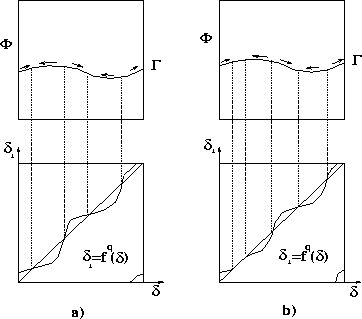
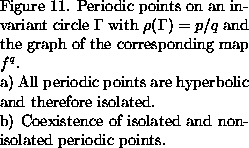
If P is a hyperbolic periodic orbit, then it is a repelling
periodic orbit for the circle map if
 , and an attracting periodic
orbit for the circle map if
, and an attracting periodic
orbit for the circle map if
 (see Figure 11).
If P is parabolic, and isolated,
P may be repelling or attracting on each side independently. It is also possible
that contains isolated periodic points, and nontrivial intervals of
periodic points as well (see Figure 11 b)).
There is a similar analysis of the one-sided derivatives of
(see Figure 11).
If P is parabolic, and isolated,
P may be repelling or attracting on each side independently. It is also possible
that contains isolated periodic points, and nontrivial intervals of
periodic points as well (see Figure 11 b)).
There is a similar analysis of the one-sided derivatives of  ,
and a natural extension of eq. 5.
,
and a natural extension of eq. 5.
Next: Aubry-Mather sets and the Up: Billiards that share a Previous: Devil's staircase
Oliver Knill