Next: Aubry-Mather Sets and the
Up: Billiards that share a
Previous: A Family of Circle
The graph of a nondecreasing function,
 , is called a devil's staircase if
there exists a family of disjoint open intervals, such that their union is
dense in
, is called a devil's staircase if
there exists a family of disjoint open intervals, such that their union is
dense in  ,
the function
,
the function  is constant on each interval and such that takes
different values on different intervals (see, e.g., [6, 8]).
is constant on each interval and such that takes
different values on different intervals (see, e.g., [6, 8]).
A rational number,  is called exceptional,
if the homeomorphism
is called exceptional,
if the homeomorphism
 such that
  is conjugate to
  .
For any non-exceptional p/q, the set
.
For any non-exceptional p/q, the set  is an interval,
 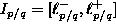 with nonempty interior.
Using the terminology of circle maps, we call
with nonempty interior.
Using the terminology of circle maps, we call
 a phase locking interval.
If p/q is exceptional, the interval degenerates to a single point
a phase locking interval.
If p/q is exceptional, the interval degenerates to a single point
 .
In this case, every point on the invariant
curve
.
In this case, every point on the invariant
curve  is periodic. From the formula in Lemma 2.2
of we get:
is periodic. From the formula in Lemma 2.2
of we get:

This leads to the following Corollary:

By differentiating this relation along a deformation, we get
necessary conditions which have to hold in an exceptional case.
Let  be a q-periodic orbit, and let
 be a deformation of O. We assume that I is an interval
with a nonempty interior,
that
be a deformation of O. We assume that I is an interval
with a nonempty interior,
that 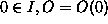 . Let
. Let  be the
polygon corresponding to O(t).
We will assume that the deformation O(t) is differentiable for
be the
polygon corresponding to O(t).
We will assume that the deformation O(t) is differentiable for  and nontrivial.
By this we mean that
and nontrivial.
By this we mean that  are
are  -functions, that
 for
for  , and that at least one
  for .
We say a periodic orbit
admits a deformation
if O is contained in an interval of periodic orbits.
for .
We say a periodic orbit
admits a deformation
if O is contained in an interval of periodic orbits.

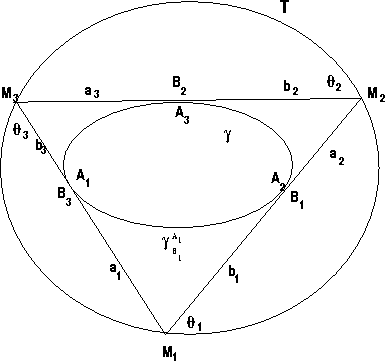
Proof. Assume a deformation O(t) exists. Let  be parameterized
by arc lengths
be parameterized
by arc lengths  .
We have
.
We have  and
and
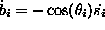 . Use this and
the mirror equation of geometrical optics to get
. Use this and
the mirror equation of geometrical optics to get

Differentiating  obtained from Equation (1) gives

This is not possible since for at least one j
and  for all .
End of the proof.
for all .
End of the proof.
|
Fig. 9. Proof of Lemma 3.3.
|

This is a special case of a more general theorem, which we have proven in
[3].
There is first of all a geometrical argument which shows that for a generic
convex curve  , the rotation function is a devil's staircase. We also
showed that if has a flat point of if
is a polygon, then the rotation function is a devil's staircase.
, the rotation function is a devil's staircase. We also
showed that if has a flat point of if
is a polygon, then the rotation function is a devil's staircase.
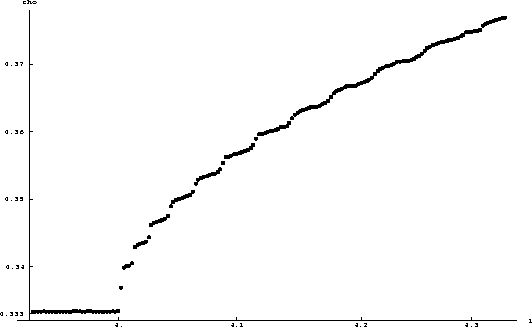
Figure 10 shows a numerically computed graph of the rotation function
in our case, when the is an equilateral triangle.
The graph shows the rotation number in dependence on  .
.
|
Fig. 10. Numerical computation of the rotation number in dependence of .
The plateau at the beginning corresponds to rotation number 1/3. The end
of the initial plateau is given by the value  . .
|
Next: Aubry-Mather Sets and the
Up: Billiards that share a
Previous: A Family of Circle
Oliver Knill, Wed Jul 8, 1998