Math 21a Summer 2025
Multivariable Calculus

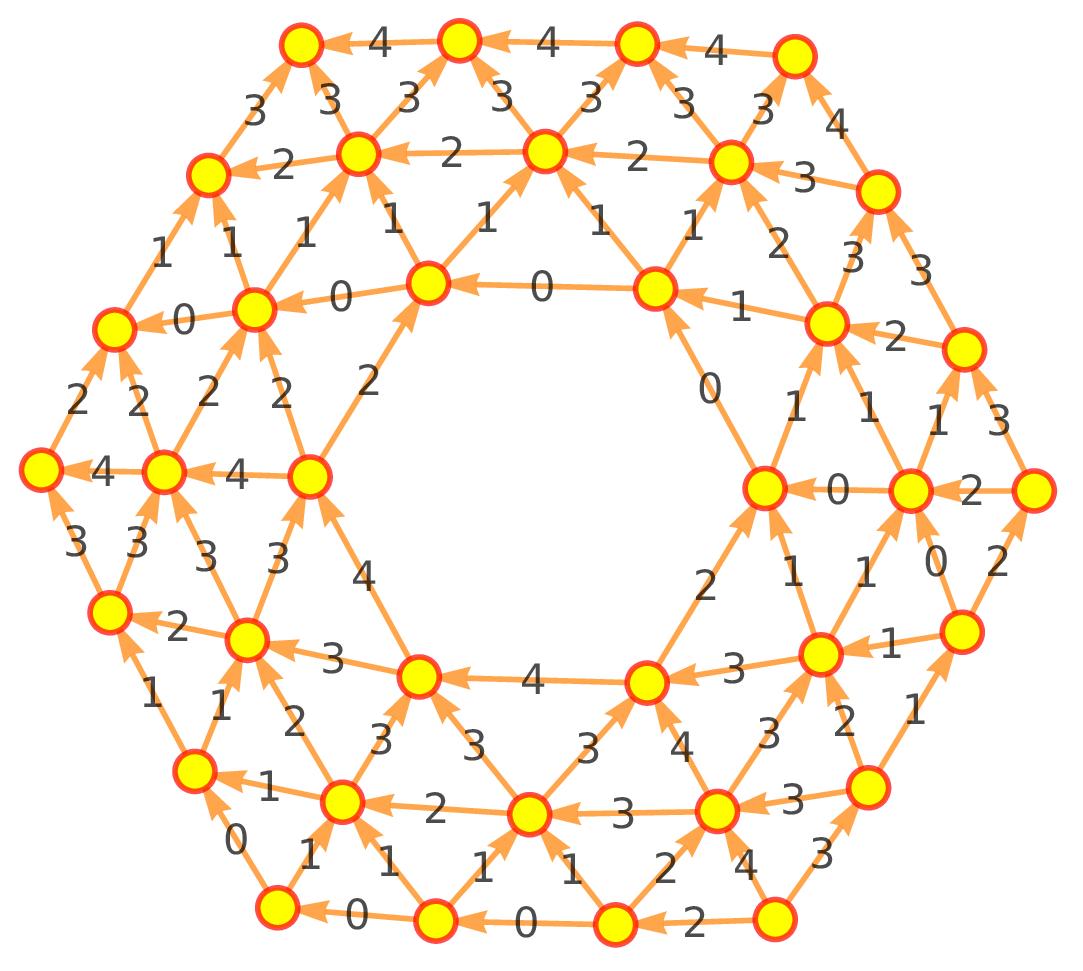
As mentioned in the intro lecture, Stokes theorem might be taught like this. Putting this problem into a final exam has good tradition: the classical Stokes theorem had first appeared in writing in a multi-variable calculus exam given by Stokes. James Maxwell took that exam as a student and got the best score. A discrete surface is given by a graph in which the neighbors of each node form either a cyclic graph (interior proints) or a path graph (boundary points) the picture below we see a surface which is a discrete cylinder. It has two boundary curves, both of which are circles. The orientation given on edges plays the role of orientations we use in the continuum when parametrizing curves. The function F on edges is a vector field. It describes how much is transported by the field from a node to each neighboring node. We have defined a gradient field of a scalar function gradient of f on the edge (a,b) is f(b)-f(a) which is a function on edges. The curl of a vector field is the line integral along the boundary. Here is the problem: Use Stokes theorem to compute the flux of the curl of F through S