Next: On this document...
Up: Billiards that share a
Previous: Periodic orbits and
In this section, we analyze the interaction of the moving invariant
circle  with the Birkhoff periodic orbits of type p/q, if
the phase-locking interval
with the Birkhoff periodic orbits of type p/q, if
the phase-locking interval  is nontrivial.
Birkhoff periodic orbits and Aubry-Mather sets.
Denote by  a lift of
  to
to
 and let R be the map
 .
A periodic orbit is called a (p,q)-Birkhoff periodic orbit, if
there exists a continuous function
.
A periodic orbit is called a (p,q)-Birkhoff periodic orbit, if
there exists a continuous function  such that
  .
It follows from a basic
fact for monotone twist maps that for any
.
It follows from a basic
fact for monotone twist maps that for any  at least two Birkhoff periodic orbits of type (p,q) exist
[18, 15, 11].
One of these orbits is a maximum of the
functional |O|, the total length of the trajectory O.
at least two Birkhoff periodic orbits of type (p,q) exist
[18, 15, 11].
One of these orbits is a maximum of the
functional |O|, the total length of the trajectory O.
Let  be the set of Birkhoff periodic orbits.
Given
be the set of Birkhoff periodic orbits.
Given  irrational. An accumulation point
(in the Hausdorff topology) of sets
as
irrational. An accumulation point
(in the Hausdorff topology) of sets
as  is called an
Aubry-Mather set and denoted by
is called an
Aubry-Mather set and denoted by  . Such a set
has the property that it is the graph of a Lipschitz continuous function
. Such a set
has the property that it is the graph of a Lipschitz continuous function
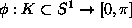 defined on some compact subset K
of
defined on some compact subset K
of  and such that a lift of
preserves the order of the covering of M [15].
and such that a lift of
preserves the order of the covering of M [15].
Typically, Birkhoff periodic points are isolated. The case
of billiards shows however that one has to deal in general with
whole arcs of Birkhoff periodic points.
If a connected periodic set Y
contains a Birkhoff periodic point, then every point in Y is a Birkhoff
periodic point and we will call a connected component
a Birkhoff periodic set. In a typical situation, a
Birkhoff periodic set is a Birkhoff periodic point.
The set of Birkhoff periodic points is isolated from the rest of
(p,q)-periodic orbits.
The index of a periodic set.
Let C be a simple, contractible oriented closed curve in  avoiding all
fixed points of
avoiding all
fixed points of  . The index
  of C with respect to the fixed points of is defined as
the Brower degree of the map
of C with respect to the fixed points of is defined as
the Brower degree of the map  ,
,
 ,
where
,
where  is calculated in a chart.
The index does not change if we deform C without intersecting
a fixed point of .
The index is also a homotopy invariant: if
is calculated in a chart.
The index does not change if we deform C without intersecting
a fixed point of .
The index is also a homotopy invariant: if  is a family of maps
and for all
is a family of maps
and for all  in some parameter interval I and C is disjoint from the
fixed points of , then
in some parameter interval I and C is disjoint from the
fixed points of , then  is constant for
  .
.
If a curve C contains only one fixed point  of , then
 is called the index of . If C contains
a connected fixed-point set
is called the index of . If C contains
a connected fixed-point set  , we call
 the
index of this fixed point set.
If a curve C contains finitely
many fixed points
the
index of this fixed point set.
If a curve C contains finitely
many fixed points  (rsp. connected fixed-point sets
  )
of , then
)
of , then  (see for example [5] Theorem 14.4.4 or [25]).
Examples. Assume C contains only
one hyperbolic periodic point of period q,
then 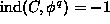 .
If C contains one elliptic periodic point, then
.
If C contains one elliptic periodic point, then
 .
If C contains no periodic point, then
.
If C contains no periodic point, then  .
More generally: if is differentiable and for a fixed point
of the matrix
.
More generally: if is differentiable and for a fixed point
of the matrix  has no eigenvalue 1, then
has index 1 if
has no eigenvalue 1, then
has index 1 if 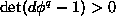 and index
-1 if
and index
-1 if 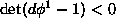 .
(See [23] Lemma 4 or [28] Proposition 3.). The index can
geometrically also be determined by
Poincaré's index formula (see [28]).
The index of a fixed point of an area-preserving
homeomorphism is bounded above
by 1 [28] [25].
From this follows by a generalized Poincaré-Hopf's theorem [27]
that if the induced homeomorphism
.
(See [23] Lemma 4 or [28] Proposition 3.). The index can
geometrically also be determined by
Poincaré's index formula (see [28]).
The index of a fixed point of an area-preserving
homeomorphism is bounded above
by 1 [28] [25].
From this follows by a generalized Poincaré-Hopf's theorem [27]
that if the induced homeomorphism  on
on  has n attracting periodic intervals and so n repelling
intervals on
(they all must have index -1), then there exist
n sets of index 1 of the same period on each side of .
has n attracting periodic intervals and so n repelling
intervals on
(they all must have index -1), then there exist
n sets of index 1 of the same period on each side of .
Remark. A periodic orbit of a differentiable
monotone twist map is a critical point
of a functional. If the critical point is nondegenerate, then the orbit
is either elliptic or hyperbolic. The Morse-index, the number of negative
eigenvalues at a critical point and the index  are related by
  . The reason is that a
nondegenerate hyperbolic orbit has even Morse-index and a nondegenerate
elliptic orbit has odd Morse-index (see [32]).
. The reason is that a
nondegenerate hyperbolic orbit has even Morse-index and a nondegenerate
elliptic orbit has odd Morse-index (see [32]).
Bifurcations of sets of periodic orbits.
We consider a one-parameter
family of monotone twist maps  parameterized by points in some interval I.
Let C be a homotopically trivial
simple closed curve in such that for ,
no fixed point of
parameterized by points in some interval I.
Let C be a homotopically trivial
simple closed curve in such that for ,
no fixed point of  is on C and such that C is
the boundary of an open subset
is on C and such that C is
the boundary of an open subset  of .
Since
of .
Since  is bounded away from 0
and
is bounded away from 0
and  Equation 2), there are only
finitely many connected fixed point sets in .
A parameter value , for which
the number of connected components of fixed points of of
in
changes, is called a bifurcation point. (Usually,
a bifurcation point is a parameter point,
for which the topological type of the fixed point set
inside C changes. Since here, only the number
of components will be relevant, we take the narrower definition.)
Index considerations limit the possibilities for bifurcations
of periodic orbits in monotone twist maps.
Equation 2), there are only
finitely many connected fixed point sets in .
A parameter value , for which
the number of connected components of fixed points of of
in
changes, is called a bifurcation point. (Usually,
a bifurcation point is a parameter point,
for which the topological type of the fixed point set
inside C changes. Since here, only the number
of components will be relevant, we take the narrower definition.)
Index considerations limit the possibilities for bifurcations
of periodic orbits in monotone twist maps.
Examples.
1) Assume, for each , there exists at least one fixed
point  of in .
Assume
of in .
Assume  is hyperbolic for
  , parabolic for
  and elliptic for
  . If is the only fixed point in
for , then
. If is the only fixed point in
for , then  is a bifurcation value
because the index of
changes from -1 to 1 and the sum of the indices
of all fixed points of in stays constant.
If two additional fixed points
of index -1 are created at , then the bifurcation is
a pitchfork bifurcation.
is a bifurcation value
because the index of
changes from -1 to 1 and the sum of the indices
of all fixed points of in stays constant.
If two additional fixed points
of index -1 are created at , then the bifurcation is
a pitchfork bifurcation.
2) Assume, a single fixed point exists in
for , and does not
exist for . Then it must have index 0 and must be parabolic.
3) Also the reversed processes are possible: for example,
two fixed points of index -1 collide with a fixed point of index 1
and leave a fixed point of index -1, or
three fixed points, two of them with index -1
and one with index 1, collide for leaving a lonely
fixed point of index -1.
Remarks.
1) If all periodic orbits of rotation number p/q are isolated, then
at least two Birkhoff periodic orbits have index different from 0 because
any periodic orbit of index 0 can be removed by a local perturbation
of the map [30].
2) The bifurcations of periodic points of a generic one-parameter family of
area-preserving maps of a surface has been classified in [22].
Passage of Aubry-Mather sets through the invariant circle.
As the parameter varies, the invariant
circle belonging to the caustic  moves up in the phase space .
At each parameter , the invariant circle divides
the phase space into a region below bounded
by
moves up in the phase space .
At each parameter , the invariant circle divides
the phase space into a region below bounded
by  and and
a region above .
and and
a region above .
For small  , the invariant circle
is near the boundary component
of the phase space .
For
, the invariant circle
is near the boundary component
of the phase space .
For  , the invariant circle
approaches the equator
, the invariant circle
approaches the equator 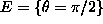 of .
Aubry-Mather sets with a fixed
rotation number pass through the moving circle .
of .
Aubry-Mather sets with a fixed
rotation number pass through the moving circle .
The passage of
with irrational is easy to describe: since each parameter value
 with irrational
is a point of increase of
with irrational
is a point of increase of  , the set of parameters
for which
intersects with consists of
exactly one point, the parameter value
, the set of parameters
for which
intersects with consists of
exactly one point, the parameter value  ,
for which
,
for which  .
The set is in general a Cantor set.
.
The set is in general a Cantor set.
If the map and the curve are smooth and satisfies a
Diophantine condition, then more can be said:
both and
depend in a differentiable way on
(see [4]). If is smooth and is
a smooth invariant curve with Diophantine rotation number , then
is accumulated by other invariant curves filling a
set of positive measure [33].
Therefore, if  is Diophantine, the moving circle
is accumulated by invariant curves which fill out a set of
positive measure.
is Diophantine, the moving circle
is accumulated by invariant curves which fill out a set of
positive measure.
We analyze, how M(p/q) which consists of
Birkhoff periodic orbits passes through if
the phase locking interval is nontrivial.
Since any periodic orbit on is a Birkhoff periodic orbit,
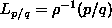 is the set of parameters for which M(p/q) intersects
.
is the set of parameters for which M(p/q) intersects
.


The picture is that for a residual set of caustics and
a dense set of parameters  , every Birkhoff periodic
orbit on the invariant curve is
isolated, hyperbolic and has index -1. Since these orbits correspond
to periodic orbits of the circle map , we can give them
coordinates
, every Birkhoff periodic
orbit on the invariant curve is
isolated, hyperbolic and has index -1. Since these orbits correspond
to periodic orbits of the circle map , we can give them
coordinates  and group them in
pairs
and group them in
pairs  .
(Compare Figure 11a). Important for us is the following Corollary.
.
(Compare Figure 11a). Important for us is the following Corollary.


Every q-periodic orbit  of the billiard map is determined by the values
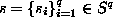 and
and  is a
critical point of the
length functional
is a
critical point of the
length functional  , which is the length
of the polygon.
, which is the length
of the polygon.

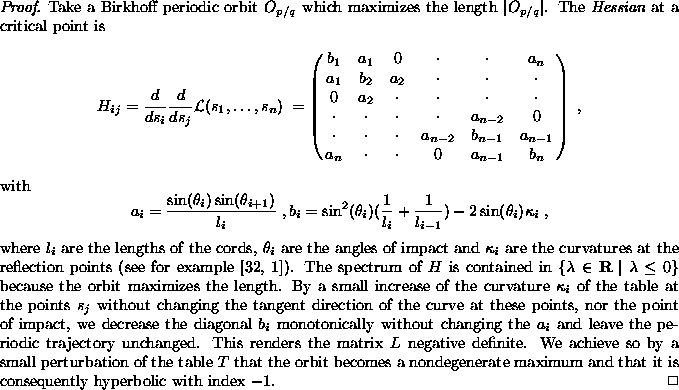
Note. We used here again the notation  ,
,  but for different things.
Since there is no danger of confusion and this notation is common for the
entries of a Jacobi matrix.
but for different things.
Since there is no danger of confusion and this notation is common for the
entries of a Jacobi matrix.


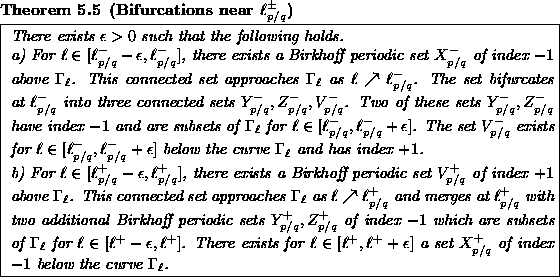
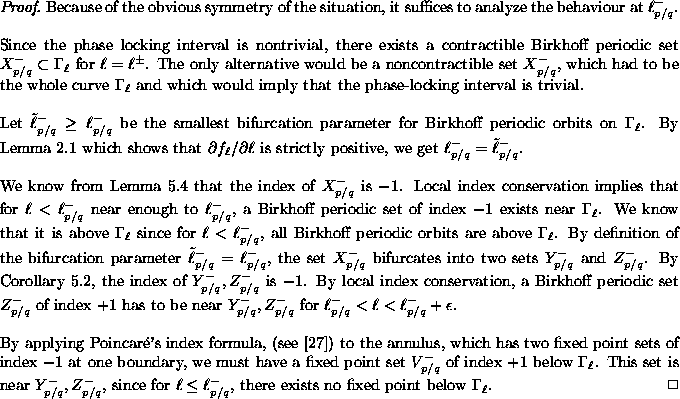
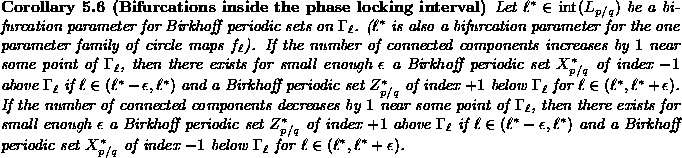
The passage of Birkhoff periodic sets of a given rotation number p/q
is in general a complicated sequence of possibly simultaneous
bifurcations. There are two basic building blocks, the passage of
an index -1 set and the passage of an index +1 set. Both events are
bifurcations and the second event
is the time reversed process of the first one. We first look at the
first rsp. last bifurcation value.
The same argument proves also:
Remarks.
1) Let us consider the motion of the non-Birkhoff periodic points of
rotation number p/q. By a
theorem of Boyland and Hall [3], they exist for p/q sufficiently
close to an irrational , if there is no invariant circle with
rotation number . For  , the non-Birkhoff periodic
points can only be above and for
, the non-Birkhoff periodic
points can only be above and for
 , they can exist only below . On the other
hand, they can not collide with . Thus, the
non-Birkhoff periodic orbits appear and disappear in the course of
the deformation.
, they can exist only below . On the other
hand, they can not collide with . Thus, the
non-Birkhoff periodic orbits appear and disappear in the course of
the deformation.
2) We believe that
typically, for sufficiently near to  ,
an isolated hyperbolic Birkhoff periodic orbit
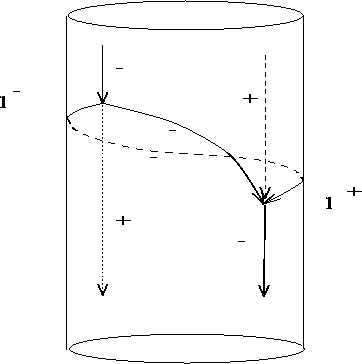
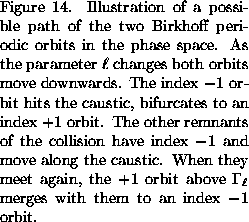
of index -1 approaches the caustic, hits the caustic as a parabolic
orbit of index -1 and leaves the caustic as an isolated elliptic
orbit with index 1. At the point , two hyperbolic
orbits of index -1 are created and move
along the caustic. They might interact with other orbits of index -1
and each of those events is accompanied with a passage of a Birkhoff
periodic orbit through the caustic as described in
Theorem 5.6. At the end of the interval
,
an isolated hyperbolic Birkhoff periodic orbit
of index -1 approaches the caustic, hits the caustic as a parabolic
orbit of index -1 and leaves the caustic as an isolated elliptic
orbit with index 1. At the point , two hyperbolic
orbits of index -1 are created and move
along the caustic. They might interact with other orbits of index -1
and each of those events is accompanied with a passage of a Birkhoff
periodic orbit through the caustic as described in
Theorem 5.6. At the end of the interval
 , the last Birkhoff periodic orbit of index 1 passes
through the caustic, changing from elliptic to parabolic
and leaves it hyperbolic with index -1.
, the last Birkhoff periodic orbit of index 1 passes
through the caustic, changing from elliptic to parabolic
and leaves it hyperbolic with index -1.
3) If the phase locking interval degenerates to one point  ,
then all the Birkhoff periodic sets hit the curve at the
same time
,
then all the Birkhoff periodic sets hit the curve at the
same time  and is exceptional
consisting of periodic points.
and is exceptional
consisting of periodic points.
4) Since by Lemma 2.1,
the circle diffeomorphisms have derivatives bounded away from
zero and , there are only
finitely many bifurcation points in  .
There are the following conservation laws for collisions of
periodic sets with the invariant curve belonging to the caustic:
to each orbit with index 1 hitting the curve
for some , there is
a set of index 1 leaving for some
.
There are the following conservation laws for collisions of
periodic sets with the invariant curve belonging to the caustic:
to each orbit with index 1 hitting the curve
for some , there is
a set of index 1 leaving for some  .
The same is true for orbits with index -1. Thus,
the sum of the indices of Birkhoff periodic orbits
passing through the caustic curve is equal to zero.
.
The same is true for orbits with index -1. Thus,
the sum of the indices of Birkhoff periodic orbits
passing through the caustic curve is equal to zero.
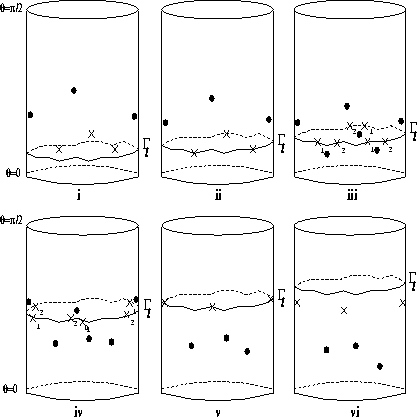
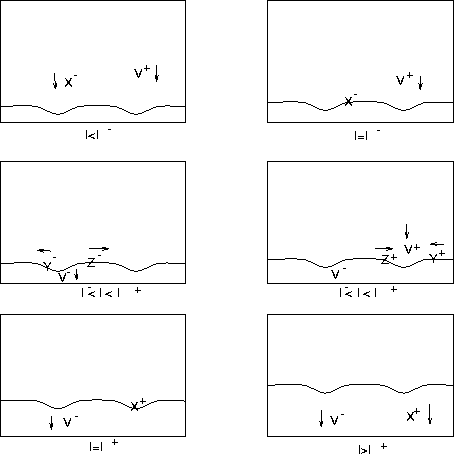
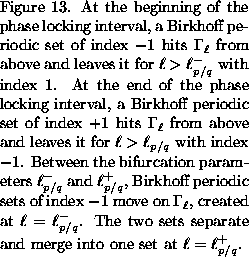
5) The pitchfork bifurcations (see Figure 13)
of the Birkhoff periodic orbit in the moments
of intersection with the caustic correspond to
saddle-node bifurcations of the circle map.
Next: On this document...
Up: Billiards that share a
Previous: Periodic orbits and
Oliver Knill
Wed Jul 8 11:57:32 CDT 1998