Math E-320: Spring 2011
Teaching Math with a Historical Perspective
Mathematics E-320:
Instructor: Oliver Knill
Office: SciCtr 434
Email: knill@math.harvard.edu
T[x_] := 4 x (1 - x); A = NestList[T, 0.3`50, 100];
S[x_] := 4 x - 4 x^2; B = NestList[S, 0.3`50, 100];
Transpose[{A, B}]
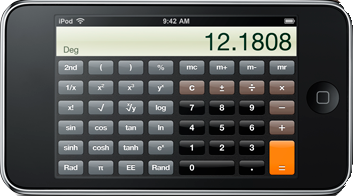
When looking for "chaotic buttons" on calculators, Matt found
that "Tan" using "Rad".
|
Here is an improved animation of the
Pythagorean tree.
|
||||||||||||||
| Snowdodecahedrons (Thanks to Christine) | ||||||||||||||
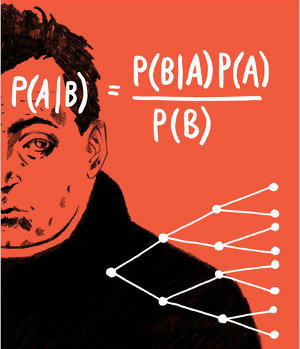
Seventh lecture: ProbabilityThe Roulette doubling paradox, which is at the start of Martingale theory was quite fun. We played in class Roulette with this game and played the doubling strategy a few times. Bet on Black, doubling each time until we win. The Martingale betting system is interesting, because our experience clashes with the mathematics. The system works with such high probability, that we become convinced that it will always do so. If we play with 1 dollar and come to the Casino every night with 40 grands (so that we can bet) and the table stake limit is 50'000, we can go to the Casino for 178 years until we expect to lose. We only get busted 16 times black fails to show up since 216=65'536. Comparing this with other risks in live this is a pretty sure thing. If there were no table stakes and we had unlimited funds, the strategy would always work. It does not contradict the fact that the expected win is always zero, because having won larger and larger sums, we also increase the possibility to lose larger and larger sums. There is no loss if we agree to play until we winning event happens and we are allowed to borrow arbitrary much money.The question is related to risk considerations in economics or environmental questions, where we ask for "reasonable risks", estimate risks which occur with very low probability like a nuclear disaster, an earth quake, an oil spill, a financial melt down, a data disaster in a "cloud computing company", or meteor crash. The risks are often very low, but as longer the time spans, the more probable they become. The question is similar for the Petersburg paradox, where no sane human would pay an entrance fee of 100 dollars even so we expect to win a lot with this entrance fee in the long term. Its just that we would not expect to win it in our life time. After class, Alexandra showed a nice card trick: sort a deck of 52 cards with alternating colors. Split the so sorted deck into two decks (making sure that the top colors are different) then shuffle once. Now pull off pairs of cards. They always have different colors. This is an amazing trick because everybody thinks that something with the shuffling is fishy. However, the trick always works and there is no cheating. Assume that we have only 14 cards. We have already split the deck. Shuffling corresponds to find a path through all the cards hitting every card exactly once going left, right or down. Here are the two decks: 1 0 0 1 1 0 0 1 1 0 0 1 1 0 0 1 1 0 0 1 1 0 0 1 1 0Now walk through the two decks, moving from the left or right forth and back making sure no card is left out. Successive pairs of cards still have different colors. After having been shown the trick, I was sure something with the shuffling was done wrong. But its simple combinatorics and our intuition fails to grasp this when we see it in action. After talking about Monty Hall, Anne mentioned a which is shown on 'deal or no deal' game TV here and in many other countries. Here is the US version and on YouTube.
Sixth lecture: Set theoryCardinality: We talked about the cardinality of numbers.N < Z < Q < A < R < Cwhere N= natural numbers, Z=integers, Q=rationals, A=algebraic numbers and R = Real numberes, C= Complex numbers. One observation which came up is that the term "natural number" is not uniformly used. Some literature uses "whole number" for 0,1,2,3,4.... and "counting number" for 1,2,3,4,5... Whether the set "natural numbers" contains zero is not always clear. We briefly looked at the task to enumerate the polynomials with integer coefficients. Is there simple way to write down a function f(n) which gives the n'th polynomial counting all. There is one as we know since Cantor, but is there a nice one which one can teach in a few minutes? Paradoxa: We also looked at the Berry paradox which asks for the The smallest integer not definable in less than 11 words. To this, Ann sent this clip. The Berry paradox is puzzling since we can enumerate all the words of length 11. There are maybe 106)11 words of this length. Some of these sentences define integers. We can make a list of all these integers and take now the smallest number which is not on the list. 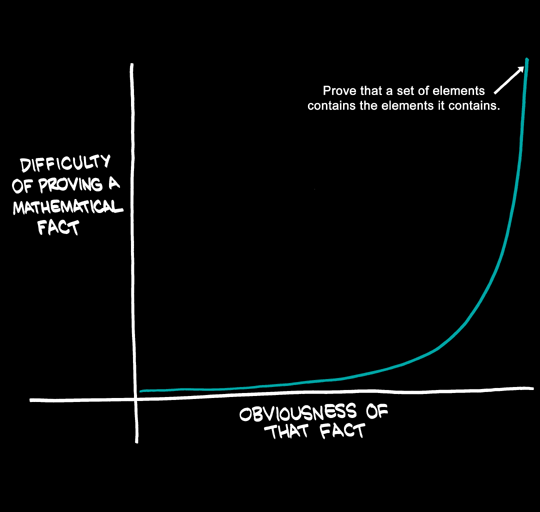 Source: About proofs Thanks Karen. Fifth lecture: Algebra
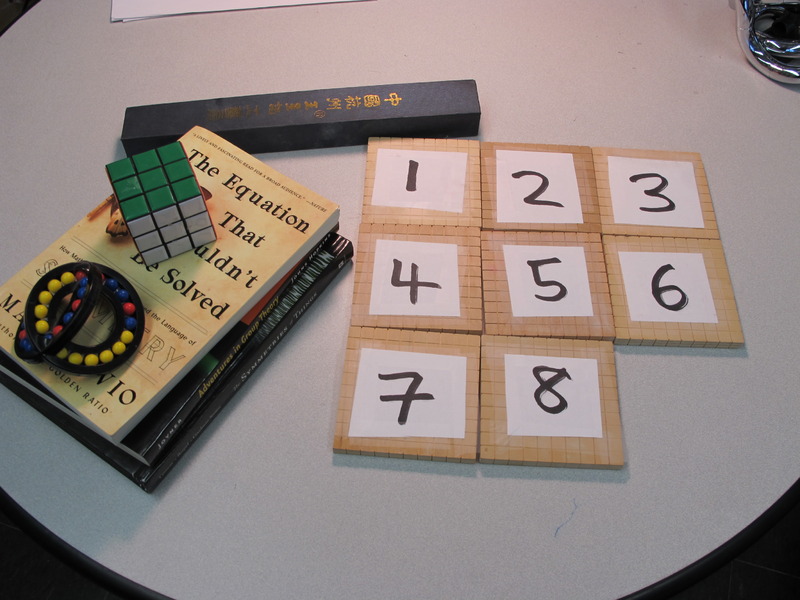
Forth lecture: Number TheoryPaul Abbott sent me the following note:
Here is your code for Gilbreath's conjecture:

s0 = Table[Prime[n], {n, 1, 10}];
diff[s_]:=Append[Table[Abs[s[[n+1]]-s[[n]]],{n,Length[s]-1}],0]
NestList[diff, s0, Length[s0]]

Here is a simpler alternative using Range, Differences, and PadRight:

With[{n=10},NestList[v\[Function]PadRight[Abs[Differences[v],n],Prime[Range[n]],n]]

Gilbreath's conjecture is usually stated in terms of
the absolute value of the differences. Here is a simple explorer:

Manipulate[NestList[v\[Function]PadRight[Abs[Differences[v]],n],Prime[Range[n]],n],{{n,10},Range[50]}]

ArrayPlot[With[{n=300},Drop[NestList[v\[Function]\[LeftBracketingBar]
Differences[v]\[RightBracketingBar],Prime[Range[n]],n],20]]]

Visualizing the sequence using ArrayPlot one sees the affect of different paddings p.:
The Rule 90 cellular automaton controls the behavior of rows that contain only the values 0 and 2:

Manipulate[ArrayPlot[Drop[NestList[v\[Function]PadRight[\[LeftBracketingBar]
Differences[v]\[RightBracketingBar],m,p],Prime[Range[m]],n],30],ImageSize->600],{{n,600},200Range[5]},
{{m,300},100Range[5]},{{p,2},Range[0,4]}]
When discussing the Ulam number spiral, we looked briefly for other ways to arrange the number line. One idea was to put the Ulam spiral onto a surface. Alexandra had the idea of adapting the curvature so that patterns would be visible. For the next picture, I placed the Ulam spiral onto a cone. Cubes were placed in space and colored according to whether they belong to a prime or not. 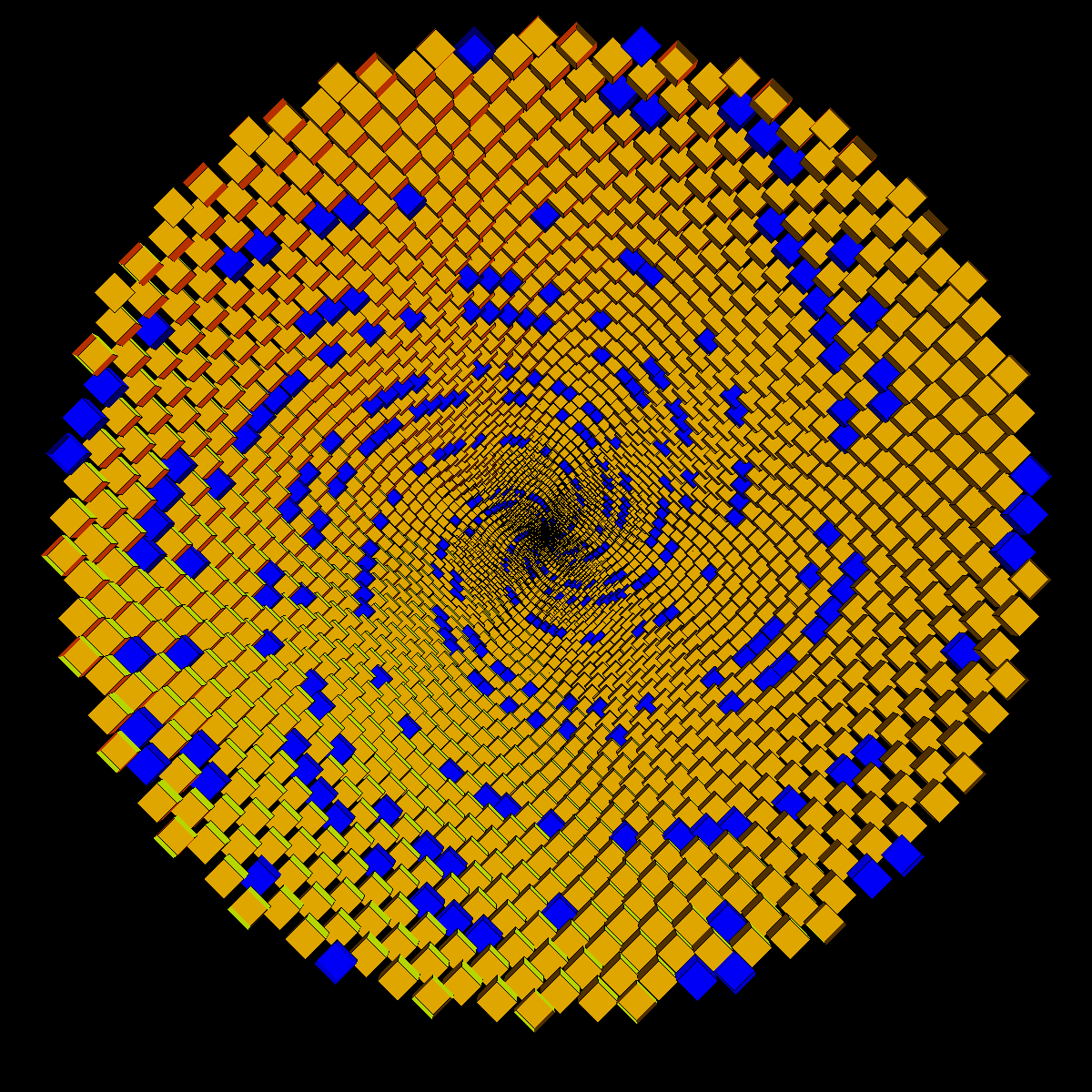
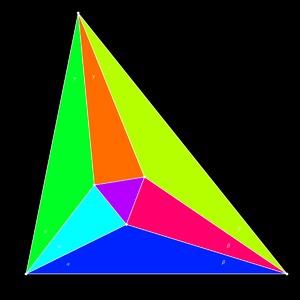
Third lecture: Geometry
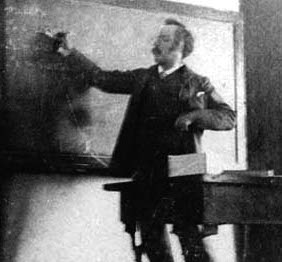 Frank Morley (1860-1937).
Image source.
Frank Morley (1860-1937).
Image source.
|
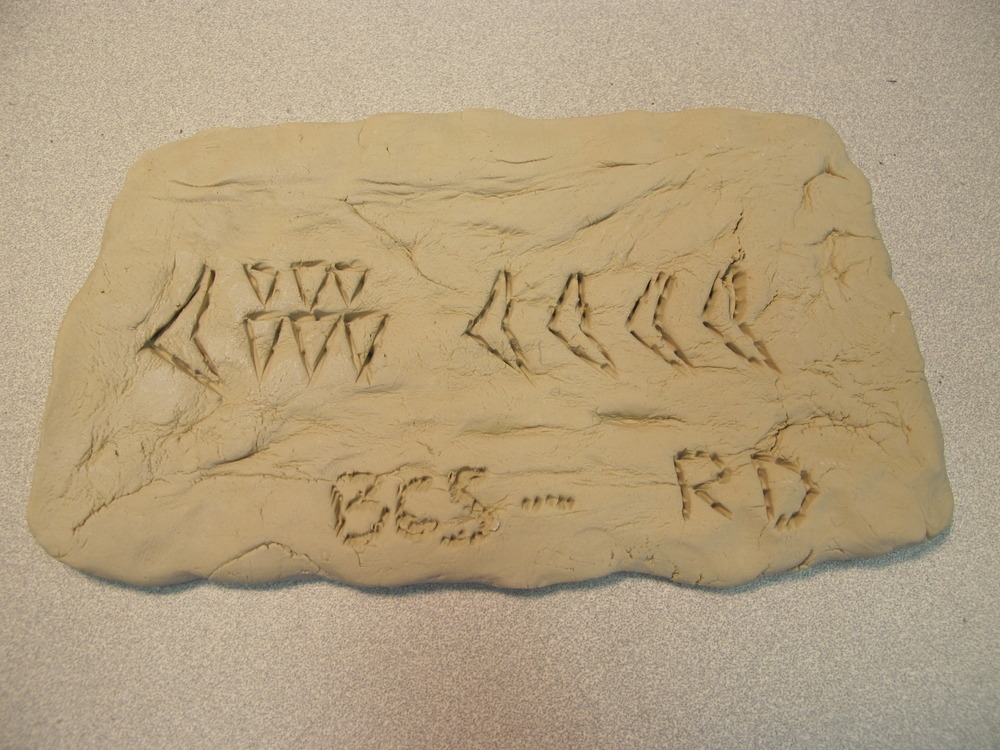
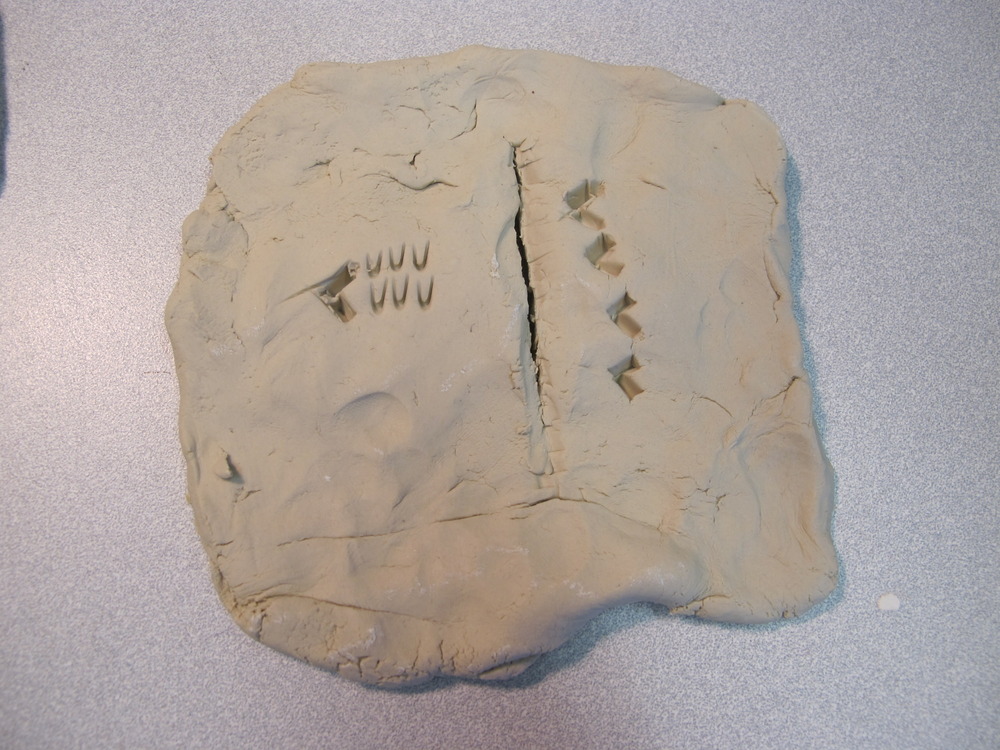
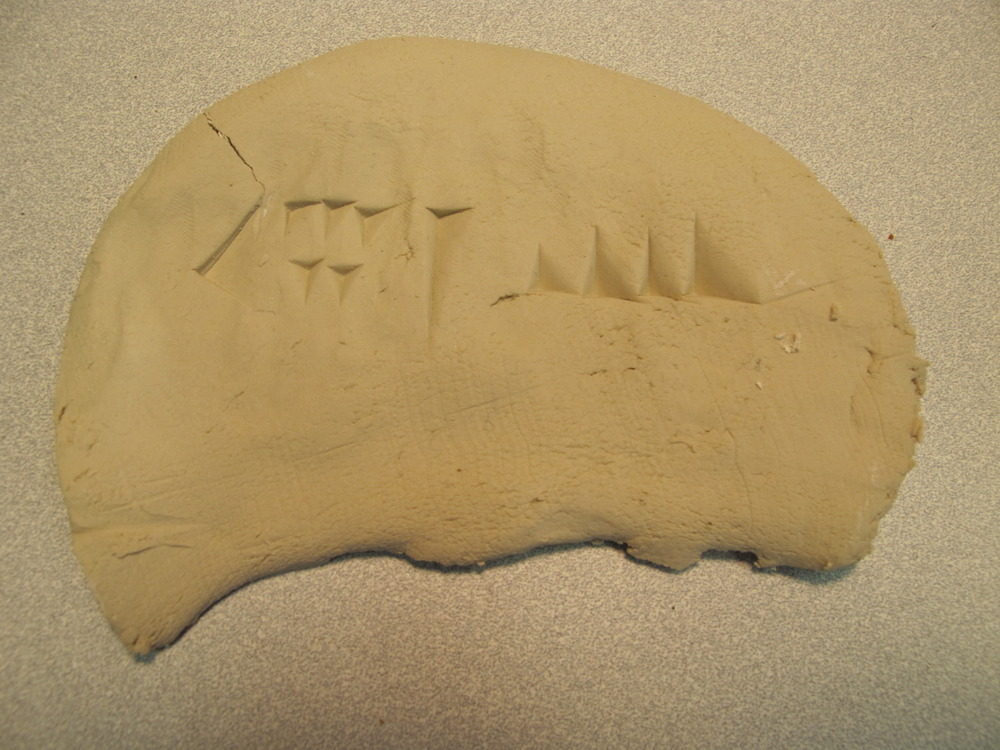
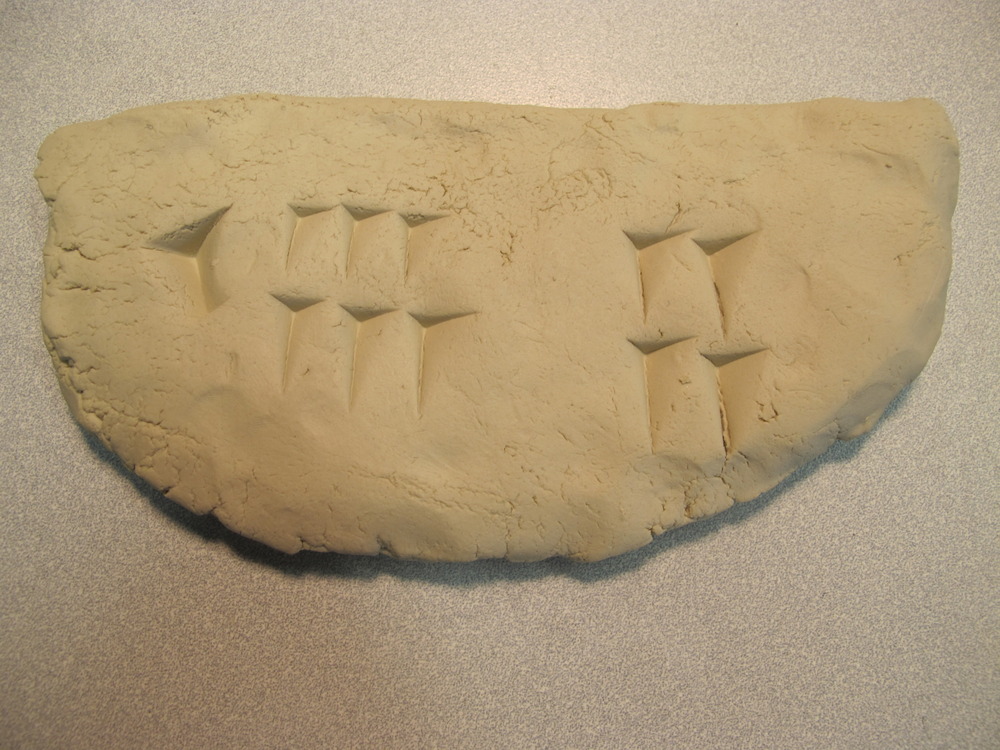
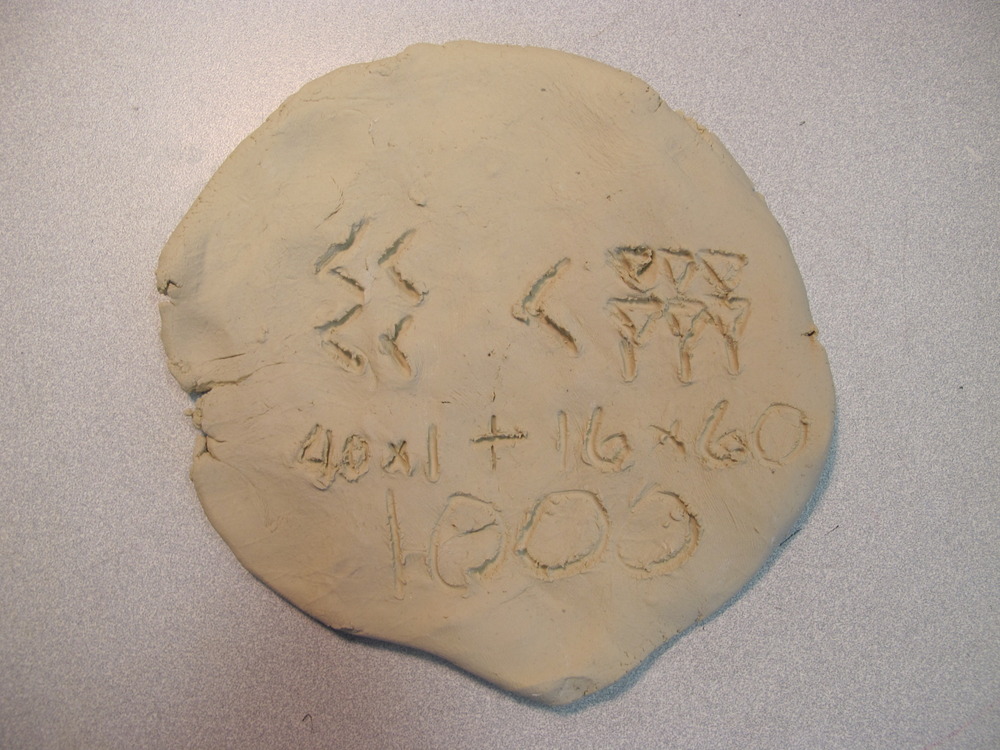
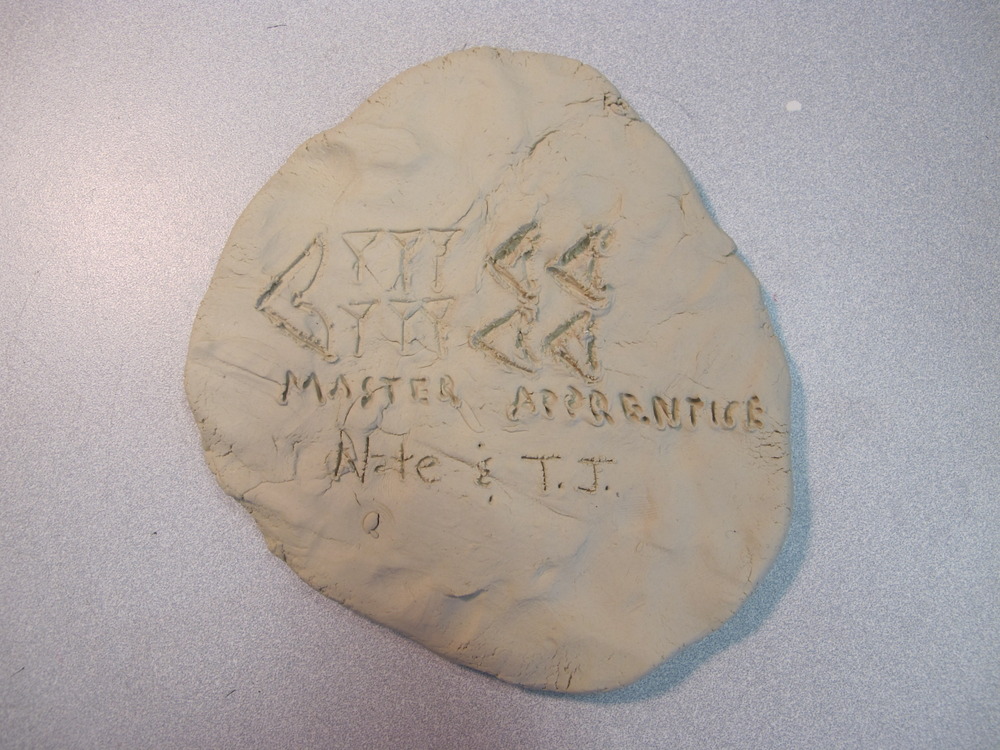
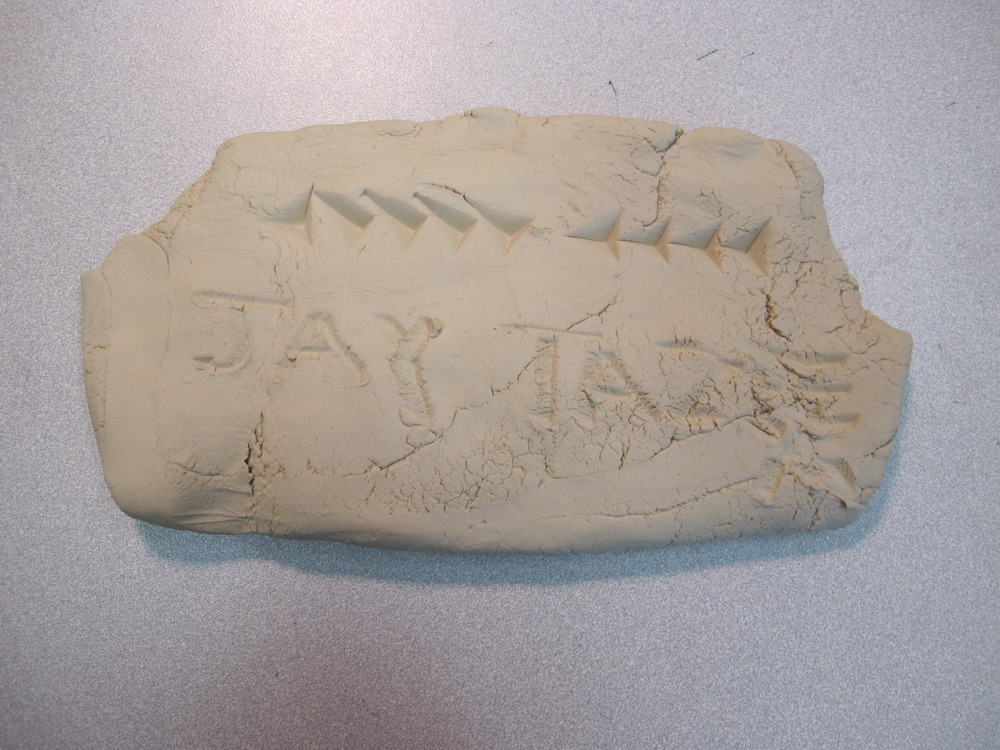
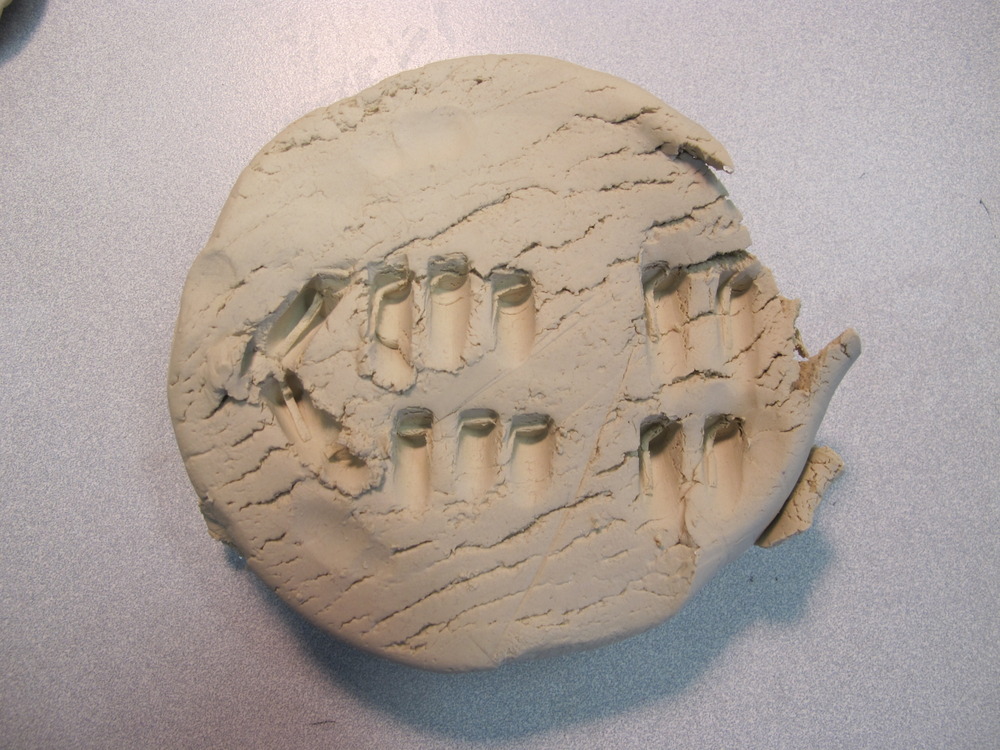
Second lecture: ArithmeticAfter a rather lengthy powerpoint show, we have written some Clay tablets. Here is an exhibit. It was illuminating to actually do it. I did not know before for example what was the reason for the wedge shaped signs. It is very easy to tilt a rectangular stick in a way to write fast and still distinguish the different directions. Here is a Youtube Video explaining it.We also worked on showing that numbers are irrational with some presentations on the blackboard.
|
First lecture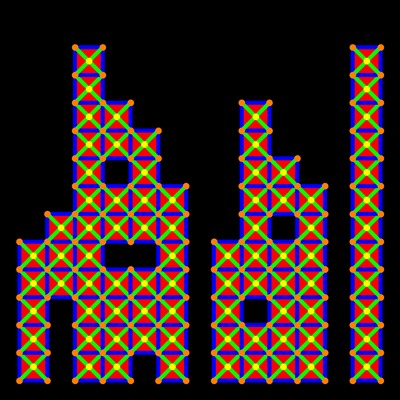 In the first lecture, we have looked at a theorem about towns. The theorem tells that
if H is the number of houses and W the number of windows in a town, then the total curvature
adds up to 6(H-W). It is an incarnation of a theorem called Gauss-Bonnet theorem.
In the first lecture, we have looked at a theorem about towns. The theorem tells that
if H is the number of houses and W the number of windows in a town, then the total curvature
adds up to 6(H-W). It is an incarnation of a theorem called Gauss-Bonnet theorem. Here is an illustration. Some observations about the lecture: The class had been faster than anticipated to compute the curvatures. It might be that even out in the field, more complicated examples could be used. Best would probably be to have students draw their own houses and towns and experiment. |
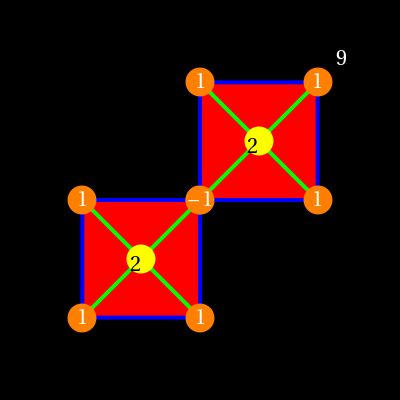 After having done the experiments, we looked at the
case where two bricks touch each other which produces a counter example to the theorem.
The class could save the theorem by assigning to the intersection point the value 2 and
consider the situation as an example with 2 houses. So, by adding an additional rule that
one assigns a value 2 to this points, the theorem stays true. An other possibility, which
works and was discovered by the class
is to assign the value -4 to such points and to consider the two bricks belong to the
same house. After having done the experiments, we looked at the
case where two bricks touch each other which produces a counter example to the theorem.
The class could save the theorem by assigning to the intersection point the value 2 and
consider the situation as an example with 2 houses. So, by adding an additional rule that
one assigns a value 2 to this points, the theorem stays true. An other possibility, which
works and was discovered by the class
is to assign the value -4 to such points and to consider the two bricks belong to the
same house.
|
| The class was most interested, how the numbers popped up. The rule is to take the circle s(x) of radius 1 centered at x and look at its length |s(x)|. Define K(x) = 6-|s(x)| for points in the interior of the house and K(x) = 3-|s(x)| for points at the boundary. One student explored the case of a "plane", where every square is filled with a brick. In that case, there are only interior points and the curvature is 2 or -2. In average the curvature is zero. The plane is is a "flat" object. |
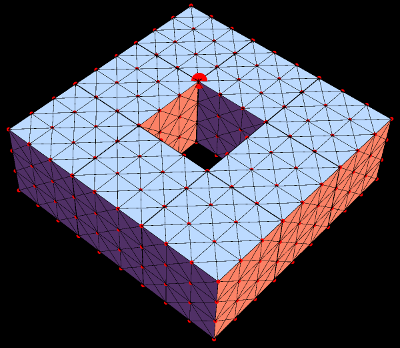 One can explore towns also in space.
It could be an interesting project for students to explore what numbers one has to
attach to the nodes so that the theorem works. The theorem is still true. The circles
of radius 1 play an important role. In the picture to the left for example, the total curvature
would be zero. There is no window in the sense we have seen before but there is a global
"hole" in the doughnut. Assume we take a single connected
surface and tile it with squares and add up the curvature, then the total curvature is still
6-6g, where g is the genus, the number of "holes". In the doughnut case displayed to the left
there is one hole and the total curvature adds up to 0. One can explore towns also in space.
It could be an interesting project for students to explore what numbers one has to
attach to the nodes so that the theorem works. The theorem is still true. The circles
of radius 1 play an important role. In the picture to the left for example, the total curvature
would be zero. There is no window in the sense we have seen before but there is a global
"hole" in the doughnut. Assume we take a single connected
surface and tile it with squares and add up the curvature, then the total curvature is still
6-6g, where g is the genus, the number of "holes". In the doughnut case displayed to the left
there is one hole and the total curvature adds up to 0.
|
| The theorem worked well to explain an important theorem in mathematics on a level which is accessible in a modest time. While the actual Gauss-Bonnet theorem involves quite a bit of mathematics to define curvature, genus, Euler characteristic etc. the graph theory version is much easier to deal with. One can experiment with a piece of squared paper, draw a town and count the number of houses and the number of windows. Mathematicians have fancier names: the number of houses is called b0, the zero'th Betti number and is the dimension of the cohomology group H0. The number of windows is the first Betti number and is the dimension of the cohomology group H1. The topic touches concepts in algebraic topology, where one tries to understand geometric objects with algebraic tools. |
 The announcement before the first lecture:
Welcome to Math E-320 2011.
Here is the syllabus.
See also the website from Last semesters course.
This class meets Mondays in Science Center, in 113 from 5:30 PM to 7:30 PM. We start on January 24th.
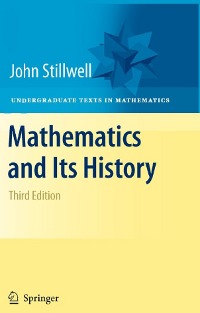
John Stillwell's book "Mathematics and its History" is a good read besides what we do
in class. In the first class on January 24th, we talk about mathematics in general
and see a short presentation. We will work then on a "mystery problem" together.
That will occupy us for an hour at least. We finish with a short quiz about the
presentation and the worksheet. Come with an open mind. There is no need
to prepare. If you want, have a look at
this handout.
The announcement before the first lecture:
Welcome to Math E-320 2011.
Here is the syllabus.
See also the website from Last semesters course.
This class meets Mondays in Science Center, in 113 from 5:30 PM to 7:30 PM. We start on January 24th.
John Stillwell's book "Mathematics and its History" is a good read besides what we do
in class. In the first class on January 24th, we talk about mathematics in general
and see a short presentation. We will work then on a "mystery problem" together.
That will occupy us for an hour at least. We finish with a short quiz about the
presentation and the worksheet. Come with an open mind. There is no need
to prepare. If you want, have a look at
this handout.
|
![[PNG]](morley/morley.png)