Technology related projects
| Techdemo, 2012. | 3D printing, 2012 | Graph project, 2011 | Structure from Motion, 2009,2007 | Geodesics, 2009,2008 | Flash PITF, 2004 | Sofia AI project 2003/2004 | CCP 2001 I,II |
Technology notes 2007-2010, 2007-2010, 2011-2015, 2016, Now
| 24-12-2010: At the beginning of the year, before the ipad has come out, I had been optimistic about tablet computers and predicted, it would be a success. I'm still enthusiastic about the device and use it daily but there are clouds at the horizon. For much of the content on the New York times for example from the iPad, a registration requirement has now popped up. For me this means to skip it. I also had tried out many of the apps which publishers gave away. Only to abandon them completely since they are not transparent on how much information of my reading habits is sent away. They obviously also are gateways to subscription models in which the user is reduced to a pure consumer, who no more is able to work with the material. These are only temporary concerns. While the hope of the industry of course is to get back into control of information, it will be futile: It only needs somebody to build an ipad emulator on the PC, which looks from the outside like a real ipad, but which allows the user to save content, record movies and sound, see what information every application sends back and filter it. This will take some time. What is badly needed in the mean time is the possibility (without jailbrake) to change the User Agent settings in the ipod/ipad browser. This would avoid also annoying automatic switches to usually buggy and reduced mobile versions of the website. With modern smartphones, mobile versions are simply no more needed. | ||||||||||||||||||||||||||||||||||||||||
| 23-12-2010: The google logo of today is based on the prototype library. It is a nice Javascript example. | ||||||||||||||||||||||||||||||||||||||||
| 21-11-2010: The new iOS 4.2 update for the ipad is great. I love to keep the book applications open (Djvu reader, ibooks and Goodreader for me). Like everybody else, the screen lock change is the only sour grape in that update. Now one has to do four steps: double tap the main button, swipe left and tap the screen lock button to switch and then tap again to get rid of the multitask bar. Its clear what the ratio is behind this change: to keep things uniform across all devices. Still a bad change, evenso I will get used to it. | ||||||||||||||||||||||||||||||||||||||||
| 20-11-2010: I have tried several note writing applications for the ipad. Each of them has advantages and disadvantages. The most recent I tried was Helvetinote, where I like that one can customize the background and also type text. It exports the notes as bitmaps and each note is only one page. Like Adobe Ideas it has a slight lag in drawing. A cloud-based note-taking-software like Evernote is not an option for me and will never be. I still like very much Penultimate which emails the notes as PDF and allows to write smaller booklets of notes. Update December 24: helvetinote became sluggish with the 4.2 update of iOS. To the point that it is almost no more usable. It also has the drawback that it does not allow backtracking. I like however to write on a black background like on a blackboard. Penultimate is still my favorite and I use it for gathering mathematical ideas or smaller computations. For more serious computations, I still prefer paper and pen. | ||||||||||||||||||||||||||||||||||||||||
| 16-11-2010: This fascinating article illustrates the limitations of online education, online grading, or the reliance on projects or papers to evaluate students. Globalization is also present on the grading part. The next step are AI tools which write papers or thesis automatically from a theme. The ultimate Turing test is to build a bot which can write a PhD thesis which passes a serious theses committee. Further down the line, bots which write research papers which get accepted in peer reviewed journals ... refereed by ghostwriter bots of course. [Update Mai 1, 2011: see a calculus lecture on artificial intelligence] | ||||||||||||||||||||||||||||||||||||||||
| 01-11-2010: The limitations of Mathematica to do scientific computations become more evident when using it on a cluster like Odyssee, where things naturally have to be parallelized. When submitting several dozens of jobs in parallel, some do not finish because of licence restrictions. I can live with other restrictions like that one has to have a graphical user interface to export graphics, but the licence restrictions seriously impact what one can do. | ||||||||||||||||||||||||||||||||||||||||
| 31-10-2010: As a die-hard VIM user, I love vimperator as an add-on for firefox. Already the ":wq" to quit the browser and start at the same spot next time, or ":history" is worth the add-on. I still have an entry set guioptions+=BmT in .vimperatorrc to see bookmarks, menu navigation since I'm not that die-hard. Update: November 11, 2010: I disabled the add-on again because it slowed down the browser. Almost unnoticably, but enough to get me annoyed. Anything (whether application or operating system) which slows me down in tasks I do thousands of times a day, is unacceptable. Even milliseconds add up. | ||||||||||||||||||||||||||||||||||||||||
| 30-10-2010: I tried out a few dozen qwikis today. Some math examples. The service "stands on the shoulders of giants", uses Wikipedia and images delivered from search engines like Google. Louis Monier, one of the qwiki founders and former Altavista and Babelfish founder, who had failed to get bought by google with "cuil". I have no doubt that the goal of qwiki will be to get swallowed up by google. It will need a lot of work to produce a search engine which produces multimedia. The start looks easy: grab the first paragraph from the wikipedia article, and read by the computer. Then grab some pictures from search engines and glue them into a slide show. Pack everything together into a movie and deliver it. See Monier at a demo. | ||||||||||||||||||||||||||||||||||||||||
| 25-10-2010: In the latest firefox builts, WebGL finally works nicely in linux. The Lorentz attractor, Game of life, Mandelbrot zoom or Wave dynamics are good examples. Its nice to show math directly in javascript without Java applets or flash. | ||||||||||||||||||||||||||||||||||||||||
| 15-10-2010: I tried out an external USB3 drive in linux. Since I have both USB2 and USB3 adapters, the last two timings in these measurements use the same 1TByte hard drive. USB3 is 1.5 times faster and reaches almost the second internal Sata drive performance. Details: FreeAgent GoFlex 1 TB USB 2.0 Ultra-Portable External from Seagate, FreeAgent GoFlex Upgrade Cable USB 3.0 - STAE104 from Seagate, USB 3.0 PCI Express 2-Port Interface Card IFC-PCIE2U3 from Buffalo. I wonder now, how reliable USB3 is, when attached over months. (Update of November 5: Why does apple not go USB3? The reason could be LightPeak, which promises to be significantly faster.) | ||||||||||||||||||||||||||||||||||||||||
| 11-10-2010: Evercookie uses standard cookies, flash cookes, web history,etags and 4 new HTML5 storage features (session, local,global, database). It is mentioned in a recent NYT article that these supercookies are difficult to delete. In firefox, I get rid of Flash cookies with rm -rf ~/.macromedia/Flash_Player; (in OSX, /Library/Preferences/Macromedia replaces .macromedia) Purging the recent history from the tools menu still leaves the pngData and sessionData. The later can be removed with rm -rf ~/.mozilla/*/*/webappstore.sqlite; For me in Firefox 3.6.10 in Ubuntu, deleting recent history and executing rm -rf ~/.macromedia/Flash_Player; rm -rf ~/.mozilla/*/*/*Cache; rm -rf ~/.mozilla/*/*/history.dat; rm -rf ~/.mozilla/*/*/downloads.*; rm -rf ~/.mozilla/*/*/cookies.*; rm -rf ~/.mozilla/*/*/webappstore.*; removes all traces of an evercookie. Removing Flash and DOM (HTML5) storage will hopefully be doable from within the browser but a small script can in the mean time do that too. | ||||||||||||||||||||||||||||||||||||||||
| 21-09-2010: There can be problems when accessing a mailbox both with the good old "mail" program as well as with "imap" clients like the apple touch or ipad or webmail. While "pine" nicely updates the "X-IMAPbase" this is not done in "mail". This has the effect that mail appears on the iMap email client even so it had physically been deleted. "Mail" does not update X-IMAPbase entries. But maybe I'm the only one still using it. | ||||||||||||||||||||||||||||||||||||||||
| 15-09-2010: The New York Times has a nice Exhibit on technology in the classroom. There are some good articles in that magazine. The exhibit could be completed a bit. See the slide in a talk of of mine of 2007. What is missing are VCR's, slide projectors, book projectors, and of course computers for Powerpoint presentation | ||||||||||||||||||||||||||||||||||||||||
| 07-09-2010: As of this morning, the google logo demo features a cool particle system. It illustrates the power of Javascript. I had made some experiments with differential equations in the browser in 1999-2000. Back to the Google systems: I did not manage yet to extract the minimal code for Google particle animation and keep it working. Here are the files with which it still works: index.html [TXT], 1.js [TXT], 2.js [TXT]. The particles are attracted to their given initial position which in the example have changed. (I deformed this part on September 8 using Mathematica). Here is the core of the Google animation. | ||||||||||||||||||||||||||||||||||||||||
| 05-09-2010: I tried out Ubuntu 10.10 on a virtual kvm machine today. I will most likely keep 10.4 with long term support but it is interesting to see whats brewing or maybe even help to find some bugs. 10.10 works well so far for me except that not all updates go through yet. | ||||||||||||||||||||||||||||||||||||||||
| 05-08-2010: Google wave seems have crashed. In October 2009, I had felt that the problem with wave would be social, people do not like to have their communications stored and monitored. It seems that complexity was also an issue: it slowed user adoption as well as developer drive. Lack of stability was the definite killer. | ||||||||||||||||||||||||||||||||||||||||
| 01-08-2010: I transfered also on my office machine the operating system onto a solid state drive. I usually start fresh and from scratch with the OS installation and Ubuntu makes this now pretty painless. I usually replace drives anyway every 1-2 years, so this was a good opportunity to double space (1T -> 2T) and get a snappier machine with SSD. I'm now on all my linux machines on ext4, which also make a difference, for example, when dealing with huge number of files in a directory. | ||||||||||||||||||||||||||||||||||||||||
| 22-07-2010: I started to use iBooks to read books on the ipad. Syncing over is still a pain: one has manually to drag the books into iTunes, where the files sit awkwardly in a folder ~/music/iTunes/iTunes Music/Books as if Books have to do with music. ` Files which are rsynced or copied with sftp to that folder do not appear in iTunes. One can also not drag entire folders into iTunes. There is a lot of room for improvement: PDF's are mostly OCRd now and metadata could be included automatically. Including DjVU reading capability would be nice. The page buildup is still a bit slow in PDF. iBook pages appear unsharp at first. What I like: the library style presentation of the books in a bookshelf and the tiny preview of the pages at the bottom of the book. iBooks is not yet an alternative for good reader. | ||||||||||||||||||||||||||||||||||||||||
| 09-07-2010: I got my new machine at home. The thinkmate workstation is perfect: clean, fast and the setup finished quickly (faster than a mac). I can easily retire the 5 year old Dell which was sucking about twice as much power and was much too loud. | ||||||||||||||||||||||||||||||||||||||||
| 02-07-2010: It is a good thing, the variety of browsers. Firefox, Chrome, Safari, Opera and of course IE. Chrome has an impressive performance. I keep Firefox, because it is the only one which is independent of a company which could in principle control the web. I in general dislike any ideology in technology but the web is too important. | ||||||||||||||||||||||||||||||||||||||||
| 17-05-2010: The old ncd.math.harvard.edu computer which I had bought in 2000 as my first office computer is now retired. The machine which is attached to a webcam is now a small ZOTAC MAG HD-NS01 computer with an Atom230 CPU, which is not larger than a book. It runs now Ubuntu 10.4 which installed well from a 8 gig flash thumb drive. [ By the way, if you install Ubuntu 10.4 from a flashdrive, copy the install CD onto the drive and install from there, netinstall options or bootstrap methods did not work for me with 10.4, the installer would fail in the middle because some files could not be fetched. Could have been temporary problems but even if it would work, there is much more work to setup the machine. The default installation does everything right. It is obviously better tested than any other installation method.] Accessing the BIOS of the ZOTAC was a bit a pain: you have to hit the Delete key fast and a lot during the boot process. I'm not the only one who had this problem. The machine is surprisingly strong. No problems also with the graphics card. Compiz has no problem. ] The relatively expensive Axis network camera, which had worked for 10 years (and still does), is replaced by a much cheaper BL-C1A Network camera, which works quite well. Both the camera as well as the computer prizes have gone down by a factor 4. In retrospect, the simplicity of the setup has payed off. Both camera and computer were very reliable. The machine had been essentially untouched the last 6 years. Failures were either due to somebody touching the cable (which is near the blackboard), or (as has happened the last month), that web access had been filtered to all machines except the main server on the math department. ncd3 was always completely locked off by firewalls. Web access is never to the camera because the computer grabs the pictures and feeds them using a reliable apache server. To further make the machine less vulnerable, access to the computer happens only by terminal. Since no maintainance is needed, this is not a problem. | ||||||||||||||||||||||||||||||||||||||||
| 13-05-2010: We are finally entirely Gigabit networked at home. Routers and switches are so reliable nowadays that I do not replace them often. The last gear I had was now 5 years old and still worked (but it was still 10/100MBit). The old Netgear Prosafe VPN, and Netgear FS608 are now replaced by a Netgear WNDR3700 Gigabit router with a Netgear Prosafe 8 port gigabit desktop switch. The newer router also made wireless faster, more secure and more stable than the Verizon default router. (Especially the iPad has had occasional problems with the older one). The new router also allows USB storage but I prefer Unix machines with external hard drives. The later is faster and more secure and of course more convenient for somebody who uses rsync for essentially all file transfers. | ||||||||||||||||||||||||||||||||||||||||
| 03-05-2010: I have now used the ipad for a month. Its nice to get up in the morning and read the news still in bed on a comfortable screen. It is fantastic to have a huge library always with me. I discover old books new. There are still some things to be smoothed out: 1) the WiFi can sometimes drop. I do not know what triggers it (maybe every 4 days) but with goodreader, the ipad can sometimes forget he password which is quite annoying. By the way, Goodreader definitely needs a better interface: while scrolling, one should see a preview of the pages, like Preview does on the mac flipping the page should be done like in Stanza, IBooks with left right, not up down buttons. The ipad is very stable so far. It did not crash a single time so far. I also love the additional cover, I bought and which protects the device. 2) Not a good buy was the external keyboard. It can not be used with the cover and taking the iPad out of the cover is difficult. The keyboard also does not work yet reliably when using SSH. 3) Using the iPad for presentation is still not possible. With the VGA cable, the presentation did not show for me now. Also, the built in keynote program is rudimentary and does not show sophisticated keynote presentations yet. For now, the iPad can not replace a laptop for showing keynote slides. | ||||||||||||||||||||||||||||||||||||||||
22-04-2010: Here is an other indication that the N[] routine in Mathematica is faulty. The following lines produce an overflow: M = 100; T[x_] := N[4 x (1 - x), M]; x=N[Pi/4,M]; Do[x=T[x],{200}] Interestingly, the Mathematica 5.1 kernel still gives an underflow error. This bug is absent, if N[] is not given a second argument. This is especially troubling because when computing with algebraic numbers, the N[] routine is screwed without a second argument. I hope that instead of throwing out a Mathematica 8.0, the next edition will be named 7.1 and fix the N[] routine. It makes numerical computations with Mathematica untrustworthy. Computing a list shows that accuracy is lost until 0 is reached but with a large exponent. While logistic map used is extremely chaotic (conjugated to a Bernoulli shift) and already after a few dozen iteration the result is numerically unreliable. But it should not happen that a computer algebra system ends up with terms like 0.*10614 leading to overflows.
| ||||||||||||||||||||||||||||||||||||||||
11-04-2010:
| ||||||||||||||||||||||||||||||||||||||||
10-04-2010: 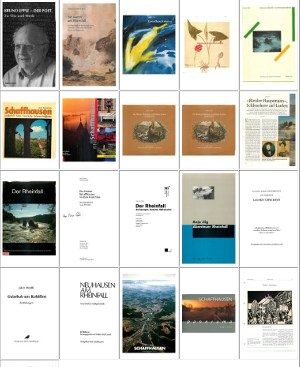 Here is how to sync a directory with electronic books (PDF's) with goodreader on the ipod or ipad: start the file transfer server within goodreader (the wireless sign at the bottom of the page on the home screen of goodreader). From an other computer (I use linux and have a folder /tmp/downloads) type: Here is how to sync a directory with electronic books (PDF's) with goodreader on the ipod or ipad: start the file transfer server within goodreader (the wireless sign at the bottom of the page on the home screen of goodreader). From an other computer (I use linux and have a folder /tmp/downloads) type: sudo mount.davfs http://192.168.1.4:8080 /tmp/downloads sudo rsync -avzu --delete ebooks /tmp/downloadsThis copies any missing files from the "ebooks" folder to the ipad. Syncing from a mac slightly more complicated if not done from the command line: network mount the address like http://192.168.1.4:8080 using "Go: Connect to Server". Then hardlink the network folder with a real folder ln -s /Volumes/192.168.1.4:8080 /tmp/downloadsso that one can rsync any content onto that folder. Now sync in the same way. Rsync of course nicely preserves any directory structure, only updates what is new and works well with thousands of files and dozens of gigabytes. This is nice for Unix minds like me who give short possibly ambiguous names to books like Sinai1980.pdf but which belong to a directory like ebooks/Math/Dynamics/Sinai1997.pdf Having the same directory structure on the ipad than on the desktop helps of course too. Since I forgot to filter out HTML files first when syncing, there is a cool additional benefit: the webbrowser interface, I have in each directory for electronic books goes over to the ipad, so that I have a nice bookshelf type interface also there. It is not as cool as in ibooks or or the "classics" application on the ipod touch. You see to the left a small snapshot of my "electronic Rheinfall library". | ||||||||||||||||||||||||||||||||||||||||
| 06-04-2010: Devices like the iPad can change academic life completely since entire libraries which would fill large rooms fit now into a small device, which is readable on a similar comfort level than the real thing. I finally figured out how to rsync my library with the ipod or ipad (using goodreader). I have had some problems in that rsync would not work with networked folders. | ||||||||||||||||||||||||||||||||||||||||
| 05-04-2010: Papers for iPad is nice too. It allows to sync the documents with iTunes. I would not like it for books. Syncing with itunes is a nice feature but apple does not allow to feed there entire folders. Anything which needs manual care is not an option for me. Still, the application is nice since it allows easily to search for material on arxiv and other repositories and include the articles nicely. "iBooks" for ebooks, "Goodreader" for PDF's, "Papers" for managing research papers, that seems like the optimum right now. | ||||||||||||||||||||||||||||||||||||||||
03-04-2010: After playing with the ipad for a few hours, here is my top list of applications which shows the potential in an educational setup:
| ||||||||||||||||||||||||||||||||||||||||
03-04-2010: 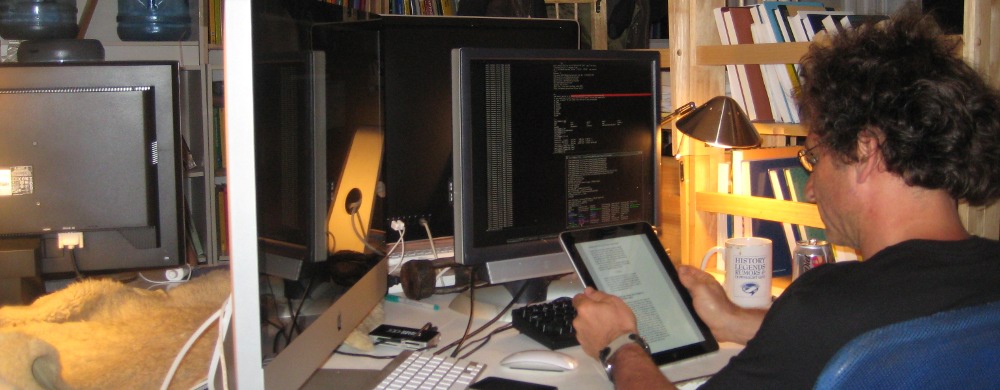 My ipad arrived. Almost all expectations are fulfilled. Its a large ipod, but thats what I need. I had wished only that iBook would allow to add your own PDF's. I currently use "good reader", which is available for the iPad (applications not upgraded for the ipad in general do not look very good on the iPad, the "good reader" is updated). I wish a DjVu reader will soon be available too and a clone of the iBook application which allows to fill in your own books. The only problem I experienced so far with the iPad is that the network password gets lost when using some applications like the "good reader". I think Pogue is wrong with the classification of people who hate or love the ipad. According to his test ("Do you use Linux, do you use Bittorrent"), I'm a "techie". But I also love the innovation of the iPad. Would I like to run any application on the device? Hell yes, but thats not the point. It will take open source years to come up with something close, if only because of patent reasons. Eventually, it will come, but for now, I need a device on which I can keep books and articles. Buy two text books and you are in the prize range of an iPad and each book is 10 times heavier. Even several of these displays could not hurt, when working intensively with papers and books. My ipad arrived. Almost all expectations are fulfilled. Its a large ipod, but thats what I need. I had wished only that iBook would allow to add your own PDF's. I currently use "good reader", which is available for the iPad (applications not upgraded for the ipad in general do not look very good on the iPad, the "good reader" is updated). I wish a DjVu reader will soon be available too and a clone of the iBook application which allows to fill in your own books. The only problem I experienced so far with the iPad is that the network password gets lost when using some applications like the "good reader". I think Pogue is wrong with the classification of people who hate or love the ipad. According to his test ("Do you use Linux, do you use Bittorrent"), I'm a "techie". But I also love the innovation of the iPad. Would I like to run any application on the device? Hell yes, but thats not the point. It will take open source years to come up with something close, if only because of patent reasons. Eventually, it will come, but for now, I need a device on which I can keep books and articles. Buy two text books and you are in the prize range of an iPad and each book is 10 times heavier. Even several of these displays could not hurt, when working intensively with papers and books.
| ||||||||||||||||||||||||||||||||||||||||
12-03-2010:
| ||||||||||||||||||||||||||||||||||||||||
| 25-02-2010: I tried out for Scholars for 15 minutes. It is quite well done. Faster than iSites and intuitive. As with all CMS, the question is, how long this will be supported. For quick projects and collaborations, this is a nice option. | ||||||||||||||||||||||||||||||||||||||||
28-01-2010: The Mathematica N[] function not only has problems with large algebraic numbers, it also does funny things with Logarithms. Try this with Mathematica 7: N[Log[Abs[Pi^60-E^55 -674515394754870253998413140641]]]Even so the argument given to the logarithm is positive, the result gives an additional I Pi as if it the inner part would be negative. This outcome does not depend on precision. One could increase also $MaxExtraPrecision. To solve the problem, give a second argument to N[]. The function N[] seems defective only, if no second argument is given. N[Log[Abs[Pi^60-E^55 -674515394754870253998413140641]],30]By the way, I saw this when horsing around to see how one would detect algebraic relations between transcendental real numbers like Pi and E. Nobody knows of course, whether such relations exist. Experiments indicate that Pi^n + E^m mod 1 does not behave differently than x^n+y^m mod 1 would do for random x,y. But who knows whether Pi^n+E^m can be rational. It would be very,very funny although. | ||||||||||||||||||||||||||||||||||||||||
08-01-2010: There is much discussion about the upcoming Apple tablet and also uncertainty whether it will be a success. I think, a well done apple tablet has a chance in education:
| ||||||||||||||||||||||||||||||||||||||||
| 06-01-2010: Some nostalgia about a Science Center Povray file written in 2000. | ||||||||||||||||||||||||||||||||||||||||
| 04-01-2010: An apple animation motivated by the current Google theme on their website. The new javascript code has about the same length and is readable. I had tried for an hour to read their code, then given up and started from scratch and finished in less than one hour. (I had been quite excited of javascript programming over a decade ago.) For small things like this, it is typically faster to start with a "tabula rasa", rather than trying the read optimized code. [Update: January 5: the apple rolls now also!] | ||||||||||||||||||||||||||||||||||||||||
| 29-12-2009: A nasty symbol microsoft – breaks copy-paste from the bowswer to a terminal in OSX. If only one of these buggers appears in a text, copy past of the entire text is impossible in OS X. In the Linux xterm, there is no problem. On the road with only OS X available, I can bypass things using "lynx -dump" and run it through the demoronizer. | ||||||||||||||||||||||||||||||||||||||||
| 27-12-2009: One of the reasons to be reluctant to invest time in closed-source technology - both operating systems and software - (for the no more so young ones like me) is that there is hardly time to "reboot". I rebooted several times in my life both with software and operating systems and want to minimize this in future. For software, there had been cases, which disappeared, not because something else would replace it but because a company would pull the trigger on the software strategically. Examples were Adobe's "streamline" to create vector graphics or early programs to build 3D objects from photographs. 3D modelling programs especially can have a short life span. I keep using Povray, Latex, GNU tools, linux because I can be sure that they will exist in 20 years and do not depend on a coorporate decision to shelf the product or modify it. There are exceptions. One are computer algebra system, where the commercial programs are so vastly superior (in an educational setup) that there is no alternative. "Sage" has chances to get into the field but it is still too complicated to use. Plotting a parametric or implicit surface, a vector field, do some linear algebra computation should not take more than one line of code and not more than 2 steps (1. Step start up the program, 2. Step, run a short one line command without additional libraries). Also the installation of the software should be simple on any platform. An other example is quicktime on apple. There is nothing like this in open source, where one can edit a movie in couple of seconds and import and export in virtually any format. | ||||||||||||||||||||||||||||||||||||||||
| 22-12-2009: As much as I dislike word processors like "Word", the successful patent fight of the company i4i illustrates that there are worse things than "difficult to learn" and "proprietary" text processors: software patents which prohibit such software to evolve and become better. A patent for a parser could produce also headaches for other companies using XML. Software patents which cover basic string processing functionality are in essence patents for mathematical structures or functors and should never have been granted. | ||||||||||||||||||||||||||||||||||||||||
13-12-2009: An interesting idea is to take a translator T from English to Japanese, a translator S from Japanese to English and iterate S*T on the set of all sentences. This website does that. Some experimentation with equilibria
This dynamical system of bi-translation looks quite interesting by itself. But it is not only a game: A good translation system should have the property that translating into various languages and back should always produce fixed points or periodic points close to the initial sentence. | ||||||||||||||||||||||||||||||||||||||||
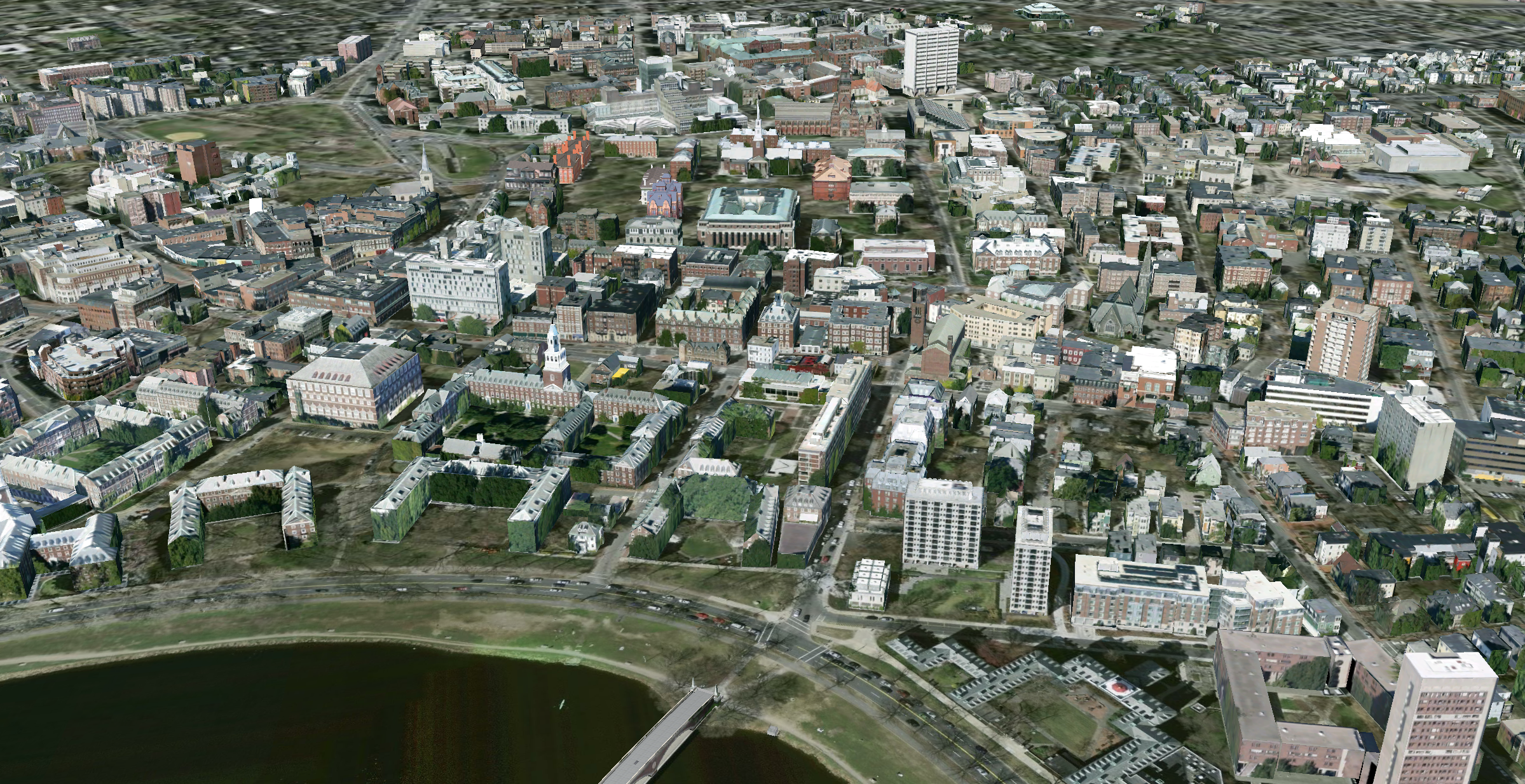
| 12-12-2009: Some newer google earth experiments on a 27 inch iMac. Its nice to be able to make large screenshots now. But its easy to get to the limits too. Recording the flights in real time with larger screens also pushes the hardware more. Google earth improved tremendously near Cambridge and Boston. | ||||||||||||||||||||||||||||||||||||||||
| 08-12-2009: Personalized search on google is here by default even if the user is not logged in. It still uses cookies and can be turned off. It shows however the trend that what we find when searching will more and more depend on who we are and where we live and what is known about us. Search becomes less objective. It is no more possible to tell to "search for 'e'" and feel lucky, because some users might end up at gossip and celebrity news and others at the mathematical constant. | ||||||||||||||||||||||||||||||||||||||||
| 04-12-2009: A post on Slashdot is more pessimistic about where the web goes: 1: the possibility to filter have grown: 2: firewalls like the one in China have become more sophisticated and more difficult to bypass, 3: the centralization has increased: less and less companies control more and more of the web, 4: the loss of internet culture has rendered the web a "blackbox" for most users. A non-free web is closer than ever because we can be pushed around without even noticing. For me, a nightmare scenario is that news content on the web is not only platform-, time- and location based, but that it is personalized: cable networks would distribute content which depends on where you live, what your contacts are, what they know about you. Conservative users or liberal users get served different content - and would even be happy about it. It already happens. CNN in Europe and in the USA have not only different content, but also different political views. Its hard to reach CNN.com from Europe or google.com from Switzerland. You are always redirected, whether you want it or not. On smart phones, users get redirected to dis-functional pages without being able to change that. It used to be that such things could be changed (i.e. change the agent name in your browser). Soon, it is no more possible to know which knowledge is objective and which is time and space independent knowledge. Very soon, we could be fed what content providers think, we want to be fed. | ||||||||||||||||||||||||||||||||||||||||
| 03-12-2009: Cashmore's list of hot trends. I mostly agree, but would bundle it differently and have 5 main hot spots: real time fueled by Twitter, Facebook, online games, google wave, localization fueled by GPS, maps, navigators, location and platform based content, data organization and aggregation by cloud and archives, media shifts like TV to web, web to phone, email to wave, web economy like micro payments or not, legal battles like content filters, privacy of data, copy rights, centralization of the web. | ||||||||||||||||||||||||||||||||||||||||
| 18-11-2009: I had been asked how Harvard might use technology as a tool in the future: here were my thoughts: Harvard is already a great place for technology in education, I had access to grants, we have site licences for expensive software like Mathematica. Three points which are important for me: 1. Culture: avoid business like temptations like HTML only email, outsourcing IT or make it dependent on non free standards like exchange. Loss of culture is also accelerated by content management systems, which can become uniform and boring. 2. Archive: social media etc are great, but with rapidly changing media, content gets lost. Fortunately, the Harvard Archive makes some heroic efforts to preserve as much as possible in a faster, database driven and gated online community. 3. Open up: CMS lead to more and more educational material disappears behind password protected walls. We all benefit from content and wisdom around us, content provided by other teachers for example, why not share it back by default. | ||||||||||||||||||||||||||||||||||||||||
| 28-10-2009: From Server culture to Desktop culture and finally to Smartphone culture. The transition from large unix servers to desktops was a similar transition than the transition from desktops to smart phones. As then, it changed the culture. Before the "desktop time", everybody knew the basics, this changed and the number of users knowing dropped. The transition from desktops to smart phones and web applications is similar. The average user knows even less. 1. More responsibility is taken away from the user. Backups for example had been the responsibility of the user. Then it became the responsibility of the company or department and it soon appears to become the responsibility of a large company. | ||||||||||||||||||||||||||||||||||||||||
| 27-10-2009: Once upon a time, when Microsoft had no email clients yet and atrocities like "exchange" were not yet even been dreamed of, everybody using email was also fluent in Unix. Instant messaging was done with "talk". "Talk" still works today and builds instant connection from one user of a Unix machine to the other. We used it a lot, for example, when my wife as a postdoc in Amsterdam and I a graduate student in Zürich. Most in academia had "talk" enabled and could be reached like this on the command line, It soon disappeared and was replaced by instant messaging and now by social networks and text messaging on smart phones. Email remained and I still use the same program like 20 years ago: mail or pine. Beats the hell out of every email client I know, even so the iphone comes pretty close. Most heavy email clients (even on Unix) have not even initiated, when email has already been read with the good old "mail" program in Unix. By the way: also "talk" is unchallenged in its simplicity. If the email address is known, one could just type "talk name@address" and off you were chatting. No additional account nor any external company like google or yahoo or apple or skype was needed as a mediator, who could pull the switch at any time. What killed "talk"? Not any new technology or feature. It was social: a typical user could just not afford any more to get interrupted while trying to do some work and most turned the feature off. | ||||||||||||||||||||||||||||||||||||||||
| 23-10-2009: What are the main obstacles to read books electronically in particular for mathematics and scientific texts? A major problem is the slowness of flipping through pages. PDF can be sluggish in this respect. Djvu is much better, but still is too slow. Even for text only. The ebook readers or even the Stanza or Kindle programs on the ipod is too slow for scanning fast through pages. PDF really can become a molasse if graphics is generated with computer algebra systems like Mathematica. Even for small documents like this exam, it had been necessary to generate much of the graphics in raster image form, and then convert it to postscript, because the vector graphics versions would be so huge that a printer would need a half an hour to print it and the page could not be read comfortably enough with Acrobat. [ Update: mathematica 8 is not better in this respect. I stopped almost entirely to generate postscript files for handouts, and render rastered pictures, convert them by hand to postscript. ] | ||||||||||||||||||||||||||||||||||||||||
| 18-10-2009: I read more books. The reason is that the Ipod turned out to be a fantastic way to "micro read" here a few pages and there a few. Especially also, since Stanza allows an immediate production of ebooks from PDFs. Even so my electronic library grows at a tremendous rate, I also buy more actual books than ever. Reasonably prized books have appeared. Similarly as with music, the electronic competition brings down book prizes into a reasonable range. Recently, a few articles on ebooks appeared: the Washington post addresses the transition to ebooks in schools, the New York Times mentions piracy, and Spiegel mentions the situation in Germany, where the transiton to ebooks goes slower. The development can not be stopped. I'm convinced that soon, 100 dollar books will be a thing from the past. Here is a book, I recently bought and which I would not want to miss in real form: the book of Conway, Burgiel and Goodman-Strauss "the symmetries of Things". An other nice book is "the Math book" by Clifford Pickover. The later has over 500 pages with nicely colored pictures and was prized less than 30 dollars. Both books use illustration which are formidable: instead of a dry encyclopedia, a nice picture illustrates. Each article is kept short. This slapstick style is taken from the web. Here is neglected example of my own, which I use also for exhibits like here. True, it can look cheap, but a short page can motivate and inspire often more than a few hundred pages of axiomatic intimidation. | ||||||||||||||||||||||||||||||||||||||||
02-10-2009: I watched finally a larger part of the google demonstration of "google wave". It contains impressive technology like "syntax aware error checking". The claim that it might one day replace email looks however unlikely to me. The major turn-off for a corporation, a group or for education could be its "big brother aspect" which also killed things like online homework. Any interaction or collaboration can be tracked in details. The "wave" can be played back like a chess game. In a collaboration project, it allows to monitor not only the amount of contribution but also the time spent which an individuum spent on what. Even when writing a draft of a sentence, this editing steps are transmitted. Sometimes, it is not the technology, but other aspects which prohibit new technology to replace an old one:
| ||||||||||||||||||||||||||||||||||||||||
| 28-09-2009: The The Harvard Modem Pool will end at the end of the month. Surprising to read that in average, still 2 users per day used it. In 2000 I still had connected too to this, typically several times per day. | ||||||||||||||||||||||||||||||||||||||||
| 25-09-2009: The iSites course emailer seems since this fall only allow sending HTML emails. There are many reasons for avoiding HTML in email: accessiblity, archiving, privacy, spam filters, text only mail readers, or simply taste. I hope this will be get changed back soon. | ||||||||||||||||||||||||||||||||||||||||
17-09-2009:
| ||||||||||||||||||||||||||||||||||||||||
| 16-10-2008: I'm happy with the new new MacBook. The graphics performance boost is noticeable, the screen and keyboard are nice. I often record video from the screen. With my old Macbook, while recording large windows, the video could be shaky. Now things work great, also with larger frame rates. | ||||||||||||||||||||||||||||||||||||||||
28-9-2008: Got Verizon FiOS installed this morning. The initial impression is very good. I have still Comcast too and can compare with speedtest: Comcast (I pay enhanced upload speed and pay 60 dollars per month): 8035 kb/s (download), 2637 kb/s (upload) FiOS 19891 kb/s (download) 4579 kb/s (upload). This is twice the speed and 15 dollars less per month. This is a typical result. Sometimes, the upload speed is over 20 megabits per second, and can be up to 3 times faster than Comcast.
| ||||||||||||||||||||||||||||||||||||||||
| 24-9-2008: Comcast throttles my upload speed (rsync). I measure 6-8 Mbit/sec download and 13-80 kbit/sec, upload speed. Yes, that is right: for upload, a modem connection is faster! It seems that upload speed is first 300kB/sec, and then it is throttled back. This is so severe that I can no more work from home (syncing content from office to home). Its time to switch to Verizon FiOS. Comcast's interference with Internet traffic was troubling already, but these throttling measures forced me through these switching hassles. | ||||||||||||||||||||||||||||||||||||||||
| 22-9-2008: Wolfram finally stopped claiming the erratic N[] behavior on algebraic integers is a "feature" or due to "rounding errors" and hints that it will probably be fixed in a future version of Mathematica. For now, its just important not to use N[] without a second argument, when dealing with large algebraic numbers. Email exchange. | ||||||||||||||||||||||||||||||||||||||||
| 18-9-2008: I argued with Wolfram research support about a severe platform independent bug (or limitation) of the N[] function of Mathematica. The function N[] has problems with transforming exact algebraic numbers to numerical numbers. Here is an example N[Sqrt[2^117 + 1]] - N[Sqrt[2^117 + 1], 100] The result is -64. The behavior of N[] is quite random: Table[N[Sqrt[2^k + 1]] - N[Sqrt[2^k + 1], 1000], {k, 1, 120}] Here is an interesting mathematical inverse problem: what is the sequence of k, for which sqrt(2^117+k) is completely off? u=Union[Table[k (-1/64) (N[Sqrt[2^117 + k]]-N[Sqrt[2^117+k],100]),{k,1000}]] It is easy to bypass the problem by just avoiding N[] and giving a second argument. In comparison, Maple projects algebraic numbers correctly into machine precision numbers: evalf(sqrt(2^117 + 1)) Its disappointing that Wolfram research do not acknowledge the behavior of N[] a problem. There is no mathematical reason, why N[] should behave in that erratic way. It can become a real problem, when doing experiments. | ||||||||||||||||||||||||||||||||||||||||
| 20-3-2008: I got a 1 Gig time capsule from apple. It did not work at first, but after an upgrade of Airport utility and a firmware upgrade of the time capsule itself, there are no problems. I even backup from linux onto it: the time capsule is mounted wirelessly on a mac mini, the linux machine backs up onto that mounted drive with rsync. | ||||||||||||||||||||||||||||||||||||||||
| 20-1-2007: After an installation of x11rec in Ubuntu, the Xorg server did not work anymore. changing "nvidia" to "nv" in /etc/X11/xorg would allow me a low resolution server. I decided to start from scratch and indeed, all the problems were gone. The cairo library problems, which had produced all this mayhem are now resolved and the machine works great. | ||||||||||||||||||||||||||||||||||||||||
| 12-21-2007: Flash is unfortunately still the only reliable way to deliver video on the web. The plugins are available on all operating systems. The newer CS3 flash program seems unable to export movies to be seen in flash 6 plugins. When exporting the movie, a dialog "WARNING: This movie uses features that are not supported in the Flash 6 player Scene=Scene 1, layer=Layer 1, frame=1:VP6 Codec requires Flash Player 8 or higher". Fortunately, the Flash 8 plugin works now reliably also in linux. | ||||||||||||||||||||||||||||||||||||||||
| 12-21-2007: Mathematica 6 does no more export graphic files without a front end. Despite many advances of Mathematica in many areas from 5->6, this would be almost a reason to abandon it. I produce many graphics files as batch jobs from the command line. When doing so, the message: "Export:nofe: A front end is not available; export of PDF requires a front end" appears Wolfram research confirmed that there is no workaround. I can not see any reason why the export procedure should check whether a front end is available (it is just writing a text file). Maybe they aim to disallow more creative use of Mathematica and so push some other products like Webmathematica. The strength of Mathematica has always been that it can be embedded well into other programs. True to the Unix philosophy, it could be part of a chain or programs or scripts. This seems have stopped. I can live with bugs and feature changes, but this is too much. I moved back to Mathematica 5 for illustration purposes and look for alternatives. I hope SAGE makes enough progress so that it can soon be used for educational use. But maybe a future version of Mathematica will reverse this. | ||||||||||||||||||||||||||||||||||||||||
10-19-2007: I like "time machine" in OSX. It comes close to the "snapshot" feature in Netapp file servers. Linux does not have anything similar, except for hand made rsync scripts. I use now a "Western digital Mybook" external hard drive with case sensitive format. The "studio edition" is quiet and has a good design. Backups from linux can be made on that drive and time machine used to keep my linux backups organized. I was not worried about the file sharing blockage because this must be implemented on the backup software level. Because the drive unmounts itself if the user is loged out, I first had to remount it by hand: "/usr/sbin/diskutil mount /dev/disk1s3". Adding a file "/Library/Preferences/SystemConfiguration/autodiskmount.plist" with content now prevents the drive to be unmounted. | ||||||||||||||||||||||||||||||||||||||||
10-19-2007: The new ipod touch is wonderful. Surfing the web works fine at home, in the sun, in the bath tub ... I'm using it all the time. In the library, just after the gym, while walking. Its a great thing. Wish list:
| ||||||||||||||||||||||||||||||||||||||||
09-19-2007: I tried out the new presentation feature in Google docs. It is still primitive but seems to work. Wish list:
| ||||||||||||||||||||||||||||||||||||||||
| 09-18-2007: The Wolfram demonstration project unfortunately does not allow the user to generate demonstrations locally on their own machine. One has to submit them to their server. It would otherwise be a great tool. Because .nbl files are closely related to .nb files, it looks possible to re-engineer the translation. | ||||||||||||||||||||||||||||||||||||||||
09-12-2007: Two remarkable statements:
| ||||||||||||||||||||||||||||||||||||||||
| 09-10-2007: What can go wrong, will go wrong: The General Does Battle With ... a Broken Mike. It happens so often. There are usually small things. Today, in our calculus teacher orientation, we presented several things on the computer. A shaky plug produced problems, the wireless mouse behaved strangely. These things remind us how fragile technology can be. In this nice video it had been predicted that computers would supervise themselves and alert of failures. |
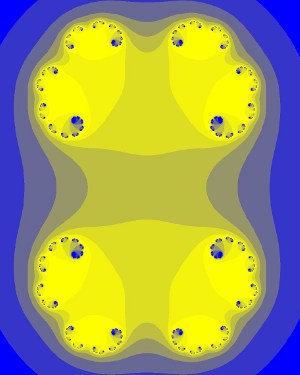 While preparing for a lecture tomorrow, I'm so glad to have still an old Mathematica 5.1 kernel hanging around. Newer Mathematica implementations have serious issues. Take
 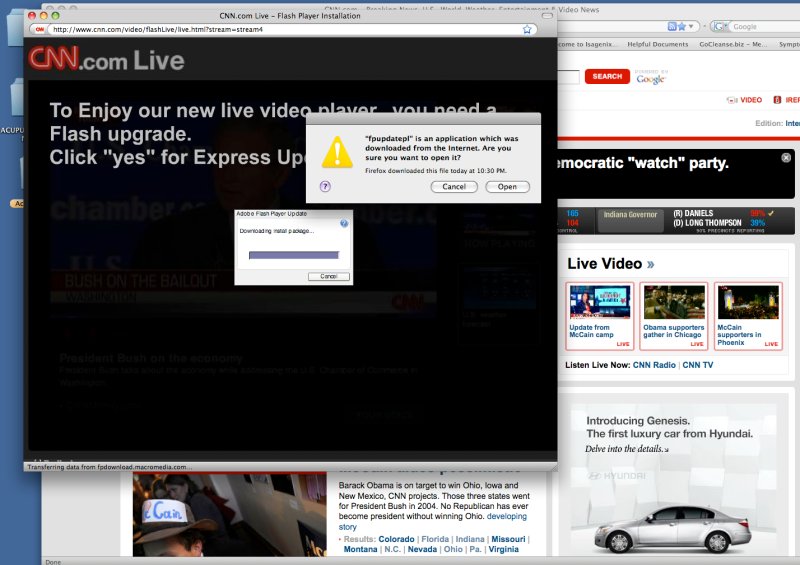 Election night. CNN has live video from the Obama and McCain head quarters. Shortly after 10 PM - it's getting more and more interesting - they decide to make an upgrade of their flash content delivery. The user has to upgrade the flash player. It would have been hard to find a better time for that. But the upgrade has a good side. It had been for many months that Linux users were excluded from Live Video at CNN. Now, CNN Live video works on my linux boxes. CNN had been one of the last places, where Linux had been discriminated.
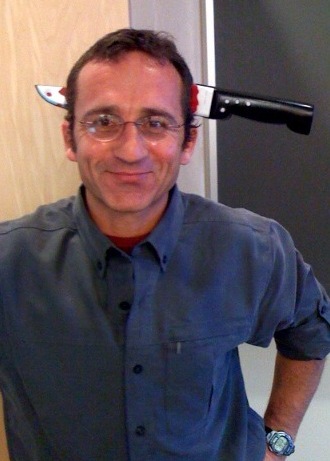 ("Cut": Photo by Kyla Horn, after my 'Halloween lecture', on Friday, October 31, 2008 in SciCenter 222.) Since new Switches were installed at the Harvard Science center, the FAS network (IP addresses 140.247.*.*) is unreachable for me from home IP address which starts with 96.233.*.*). Technicians at Verizon have verified that it is not their problem (nor is it a router or firewall problem at my home). Since Wednesday, the 29'th, I know, how it is like to live in a country, where access to certain pages is forbidden: proxy servers have become my friend as well as hosts of websites I own and through which I can sync content from home to my office and back. It is certainly a silly mistake in some firewall rule, but its frightening to see how easily it is possible to be switched off. Its like being killed by a knife (got me the idea for my Halloween costume).